Free concrete calculator
Cubic yards for a ready-mix order, or the number of 60lb or 80lb bags for a slab you mix yourself.
Enter concrete dimensions
Project type
Length (ft)
Width (ft)
Thickness (inches)
4 inch typical slab
Waste percent (%)
10 percent standard
Price per cubic yard ($)
Bag size
Labor rate ($ per sq ft or total)
3D preview · drag to rotate 0°
Slab
Quick examples for invoices
Your concrete estimate to invoice
$404.00
Total to invoice - $204 concrete + $200 labor
Formula text
Invoice line item template for concrete
Line item
Watch the calculator fill itself in
The same panel you used above, working out a 20 by 12 foot slab at 5 inches: volume, the waste allowance, bag counts and the cost at your yard price, updating as each field is typed.
Your concrete order
0.00 yd³
Cubic yards with waste
yd³ = L × W × T ÷ 27
If the pour grows
Start with the amount you need to borrow
From yardage to an invoice that gets paid
The volume is the easy part of a concrete job. These are the four places the money goes missing between working out the order and being paid for the pour.
Quote the pour, not the concrete
Concrete is rarely half the finished cost. Excavation, gravel base, forms, mesh, labor and the finish are the rest, and a client who was quoted a yard price will argue about every one of them later.
Itemize it once on a written quote and the conversation is over before it starts.
Waste is a cost, not a rounding error
The 10 percent you add for uneven subgrade and what stays in the drum is real money on a large pour. Price it in rather than absorbing it, and note on the quote that surplus concrete cannot be returned once it is batched.
The profit margin calculator checks the job still pays once that is counted.
Access and short loads change the price
A pump, a wheelbarrow run, or a supplier's short-load fee can cost more than the concrete on a small job. They are decisions made before the truck is booked, so they belong on the quote rather than on a surprise invoice.
Say plainly what is included and what triggers an extra charge.
Invoice the day the pour is finished
Concrete is one of the few trades where the work is unmistakably complete: it is either down or it is not. Bill it that day, with the yardage, the finish and the terms on the page.
The invoice generator takes the same lines you quoted, so the two documents agree.
A margin is a decision, not a calculation
Set the margin
Cost in, margin out, or name the margin you need and take the price it gives you. Check it per line rather than across the whole job.
You are hereQuote at that price
Put the price in writing with what is included, a deposit and a valid-until date, so the figure you calculated is the figure you are held to.
Open the Quote MakerInvoice and collect
Bill the day the work is done, with terms, a due date and a stated late fee. Waiting 60 days for payment can cost more than the job earned.
Open the Invoice GeneratorBorrowing to cover the gap between doing the work and being paid? The loan calculator prices that properly, fees included, so you can compare it against simply asking for a deposit.
Why use a concrete calculator instead of doing the math by hand?
Know how much concrete to order before the truck is booked. It works as a cubic yard calculator for ready-mix and as a concrete bag calculator for the jobs you mix on site. Enter your dimensions for cubic yards, cubic feet and 60lb or 80lb bag counts, with a waste allowance, the cost at your yard price and a line you can drop straight onto an invoice.
Cubic yards you can order
Enter the length, width and thickness. The calculator works out cubic feet as length times width times thickness in feet, then cubic yards as cubic feet divided by 27. Example: a 10x10 slab at 4 inches is 33.33 cu ft, or 1.23 cu yd. Add 10 percent waste for spillage and an uneven base.
Bags for the jobs you mix on site
Choose 80lb, 60lb or 40lb bags and the count is worked out on the volume with waste, rounded up to whole bags, so the order covers the pour.
Eight shapes
A line ready for the quote
Enter your price per yard and the labor, and the calculator writes the invoice line with the yardage, the waste allowance and the cost, ready to paste into a quote or an invoice.
How many bags of concrete for a slab?
Work out the volume in cubic feet, add the waste allowance, then divide by what one bag yields: about 0.6 cubic feet for an 80lb bag and 0.45 for a 60lb bag. Round up, because a part bag is still a bag you have to buy. For a 4 inch slab with 10 percent waste, that comes to:
| Slab (ft) | Cubic yards | 80lb bags | 60lb bags |
|---|---|---|---|
| 4 x 4 | 0.22 | 10 | 14 |
| 6 x 6 | 0.49 | 23 | 30 |
| 8 x 8 | 0.87 | 40 | 53 |
| 10 x 10 | 1.36 | 62 | 82 |
| 10 x 12 | 1.63 | 74 | 98 |
| 12 x 12 | 1.96 | 89 | 118 |
| 10 x 20 | 2.72 | 123 | 163 |
Past about one cubic yard, 45 or more 80lb bags, mixing by hand takes most of a day and the batches are hard to keep consistent, which is where a ready-mix order usually wins even with a short-load fee. For a 6 inch slab, multiply the counts by 1.5. On a quote, the bag count belongs on the materials line and the mixing time on the labor line, so the client can see both; the estimate maker lays a whole job out that way.
How to calculate concrete for slabs, footings, walls and stairs
Every shape uses length, width and depth in feet, then divides by 27 to get cubic yards. Use the calculator above so you skip the manual math, then copy the result to your invoice.
1. Slabs and walls - rectangular
Formula: CY = L x W x H(ft) / 27 | Example: 15x10x0.5/27 = 2.78 yd³
2. Circular slabs and post holes - round
For round slabs, circular pads, patios, post holes. Measure radius ft which is diameter divided by 2, and depth ft. Formula cubic yards equals pi times radius squared times depth divided by 27. Pi 3.14. Example circular slab radius 6 ft depth 0.5 ft 3.14 times 36 times 0.5 equals 56.52 cu ft divided by 27 equals 2.09 cubic yards. Use Circular Slabs mode in calculator enter radius and depth get cubic feet cubic yards cubic meters. Use it for round patio pads or several post hole foundations.
3. Square and rectangular footings
Formula: CY = L x W x D / 27 | Example: 8x2x1.5/27 = 0.89 yd³
4. Round footings, columns, piers
Formula: CY = π x r² x D / 27 | Example: 3.14x1.5²x2/27 = 0.52 yd³
5. Curb and gutter - long and narrow
For curbs, gutters, sidewalks, driveways, parking lots, street edges. These are long narrow runs. Enter curb depth, gutter width, curb height, flag thickness, total length ft into Curb and Gutter section. Calculator returns cu ft cu yd cu m without manual math. Formula cubic yards equals length times width times depth divided by 27 using combined cross section. A 100 foot curb, 1.5 feet wide and half a foot deep, comes to 2.78 cubic yards. Measure length, width and depth, convert to cubic yards, and you buy the right amount.
6. Stairs - multiple steps
Formula: CY = Steps x L x W x H / 27 | Example: 10x3x4x0.5/27 = 2.22 yd³
7. Concrete yardage - quick estimate
Formula: CY = L x W x D / 27 | Example: 20x15x0.5/27 = 5.56 yd³
9. Concrete price for contractors - how to price and invoice
Contractor pricing combines material, labor, equipment, overhead, profit margin. Estimate volume multiply by material cost then add labor and other expenses. That gives you a price that is profitable and still competitive. Example material 4 yards times $100 per yard equals $400 labor 3 hours times $50 per hour equals $150 equipment $50 total before profit equals $600 profit 20 percent equals $120 final price $720 to invoice. Add markup on top with the profit margin calculator, then carry the figure into an invoice.
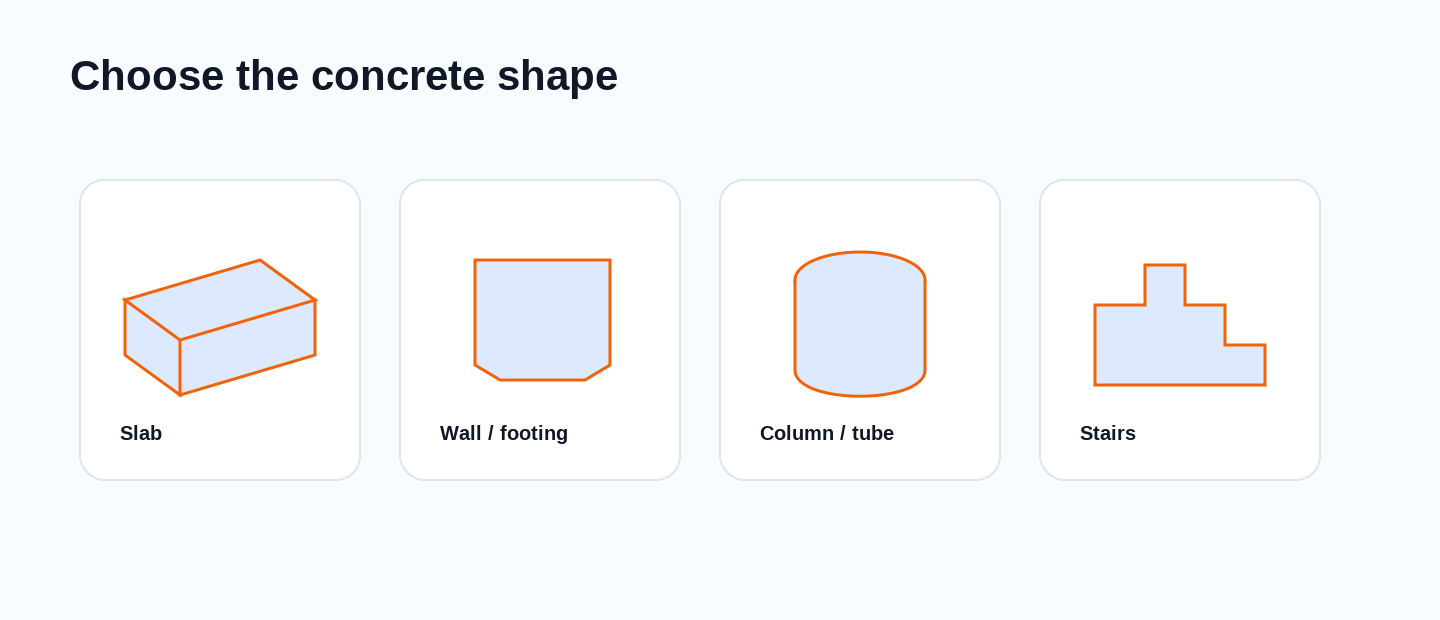
Which concrete shape fits your pour?
Quick cubic yard, bag and cost calculators
Slab size → concrete volume
Length
Width
Thickness
Formula: (Length × Width × Thickness/12) = Cubic Feet, ÷27 = Cubic Yards
Result: 33.33 cu ft = 1.23 yd³
Example: 10 ft × 10 ft × 4 in thick = 33.33 cubic feet = 1.23 cubic yards of concrete needed.
Cubic yards → bags needed
Total Concrete
Bag Size
Formula: (Cubic Yards × 27) ÷ Bag cu ft = Number of bags
You need: 56 bags of 80lb bags
Example: 1.23 yd³ = 33.21 cu ft ÷ 0.6 = 56 bags (we round up).
Cubic feet → cubic yards
Cubic Feet You Measured
Formula: Cubic Feet ÷ 27 = Cubic Yards
Result: 1.23 yd³
Example: 33.33 cu ft ÷ 27 = 1.23 cubic yards.
Cost → total to invoice
Volume (with waste)
Includes 10% waste
Price per Yard
Ready-mix $120-$200
Labor Cost
Flat or per sq ft
Formula: Concrete Cost = Volume × Price per Yard, Total = Concrete Cost + Labor
Concrete cost: $204 | Total to invoice: $404
Example: 1.36 yd³ × $150 = $204 concrete + $200 labor = $404 total to put on invoice.
Concrete Volume Comparison Table - Live Examples
How different shapes convert to cubic yards
| Shape | Formula | Example Input | Result Cubic Yards |
|---|---|---|---|
| Slab 10×10×4in | L×W×H/12 ÷27 | 10×10×0.33 ft | 1.23 yd³ |
| Footing 20ft long | L×W×D ÷27 | 20×1×1 ft | 0.74 yd³ |
| Column 12in dia 4ft | π×r²×H ÷27 | r0.5ft H4ft | 0.12 yd³ |
| Curb 100ft | L×W×D ÷27 | 100×1.5×0.5 ft | 2.78 yd³ |
All values include exact volume. Add 10% waste for ordering. Full calculator above adds waste automatically.
How to work out how much concrete you need in five steps
Enter length width thickness
Measure the length and width in feet and the thickness in inches; a 4 inch slab is typical, 6 inches for heavy loads. The calculator converts thickness from inches to feet by dividing by 12. Example: a 10x10 slab at 4 inches is 0.33 ft thick.
Sample invoice clause for concrete
Concrete slab, 10 ft by 10 ft at 4 inches thick. 1.36 cubic yards including 10 percent waste, 62 bags at $150 per cubic yard: $204 of concrete and $200 of labor, $404 in total, plus tax and any delivery fee. 50 percent deposit before the pour. Includes prep, pour, finish and cleanup. Change the figures to the ones the calculator gives you for your job.
Concrete examples: slab, footing, column, curb and stairs
How is concrete volume calculated? The formula explained
Concrete formula and methodology
Volume is length × width × thickness, all in feet, divided by 27 to reach cubic yards; thickness in inches is divided by 12 first. Circular pours use π × radius² × depth, footings and curbs use the rectangular formula along their run, and stairs are the number of steps × rise × run × width. Waste multiplies the result by one plus your percentage. Bags are the cubic feet with waste divided by the yield of the bag: 0.6 for 80lb, 0.45 for 60lb, 0.30 for 40lb. Cost is yards with waste × your yard price, plus labor at your rate, plus whatever margin you price the job at. Nothing is stored and no data leaves your browser. Figures are estimates for planning and quoting; confirm the order with your supplier.
Concrete questions, answered
Common questions about concrete quantity, bags, cost, price to invoice concrete jobs.
How do I price a concrete job for a client?
Take the yardage here, add delivery and any short-load fee, then excavation, base, forms, reinforcement, labor and finish. Concrete is rarely half the finished cost, so pricing off the yard price alone is how a job earns nothing. The invoice line the calculator writes goes straight into the quote maker, and the contractor invoice template covers billing the job once it is poured.
Do I need rebar or mesh?
Most slabs use mesh or rebar to control cracking, and anything carrying vehicles should have it. It is priced by area rather than volume, so quote it as its own line.
How do I quote for difficult access?
As its own line, priced before you commit. A pump or a long barrow run can cost more than the concrete on a small job, and it is a decision made when the truck is booked rather than a surprise on the invoice.