The short version
A donation receipt is the charity's written acknowledgment. Give one for any single gift of $250 or more, state the cash amount or describe the property without valuing it, and say whether you gave anything back. If the donor paid more than $75 and got goods or services, you must also tell them, in writing, that only the excess over the value received is deductible. Do not ask for a Social Security number.
Donation receipt builder
The text follows IRS Publication 1771. Nothing you type leaves this page.
What the IRS says the acknowledgment must contain
From the IRS page on written acknowledgments and Publication 1771, read 5 November 2026:
- Name of the organization.
- The amount of cash contributed, or a description, not a value, of any property.
- A statement of whether the charity provided goods or services in exchange, or that it did not.
- If it did, a description and a good faith estimate of their value.
- If the only benefits were intangible religious benefits, a statement saying so.
Nothing else is required. The date is wise to include, and so is the donor's name, but a Social Security or tax number is not needed on the acknowledgment.
Who must do what
- The donor is responsible for obtaining the acknowledgment before claiming a deduction for any single contribution of $250 or more. Without it, the deduction can be disallowed.
- The charity must give a written disclosure to donors who pay more than $75 and get something back. The IRS penalty is $10 per contribution, up to $5,000 per fundraising event or mailing, unless there was reasonable cause.
- Under $250 in cash, a bank record or a written communication that shows the charity's name, the date and the amount is enough for the donor. A receipt is still good practice.
Four gifts, four answers
Computed by the same code as the builder above. The deductible part is the payment less the value of what the donor received.
| Gift | Paid | Value received | Deductible part | Acknowledgment ($250 or more) | $75 disclosure |
|---|---|---|---|---|---|
| $250 cash, nothing received | $250 | none | $250 | Yes, $250 or more | No |
| $150 gala ticket, dinner worth $60 | $150 | $60 | $90 | No, under $250 | Yes, over $75 with a benefit |
| $50 charity concert ticket, seat worth $40 | $50 | $40 | $10 | No | No, $75 or less |
| $1,000 donation with a $150 gift | $1,000 | $150 | $850 | Yes | Yes |
The gala line is the one that trips charities up. A guest pays $150 for a ticket and eats a $60 dinner. Their payment is under $250, so no acknowledgment is required, but because it is over $75 and they received a benefit, the charity must give the disclosure. The text the builder writes for that case is below.
Riverbend Food Pantry (EIN 00-0000000)
Donor: Sam Lee
Date received: October 12, 2026
Cash contribution: $150.00
In return for this contribution we provided: a dinner for one. Their estimated fair market value is $60.00.
The part of your payment that may be deductible is $90.00 (your payment less the value of what you received).
Thank you for your support.
A plain gift and a property gift
For a cash gift with nothing given back, the wording is short:
Riverbend Food Pantry
Donor: Ana Ruiz
Date received: October 12, 2026
Cash contribution: $250.00
We did not provide any goods or services in exchange for this contribution.
Thank you for your support.
For property, the charity describes the gift and says nothing about its worth. The donor decides the value and, above $500, reports it on Form 8283.
Riverbend Food Pantry
Donor: Lee Wu
Date received: October 12, 2026
Contribution: Three boxes of winter coats. As the organization, we are not stating a value for this gift.
We did not provide any goods or services in exchange for this contribution.
Thank you for your support.
Items of token value, such as a pen or a bumper sticker, are treated as insubstantial and do not need to be valued in the disclosure. Check Publication 1771 for the current dollar limits before you rely on this.
Timing
The acknowledgment has to exist before the donor claims the deduction. Publication 1771 describes a timely written communication as one the donor receives on or before the earlier of the date they file their original return or its due date including extensions. So a receipt sent in the weeks after the gift is safe, and one requested the following autumn may not be. Send one at once, and a year-end summary in January that lists each gift. The receipt can be an email. The IRS says a written communication includes a receipt, a letter or an email, so a PDF attached to a thank-you message works.
Open it as a designed receipt
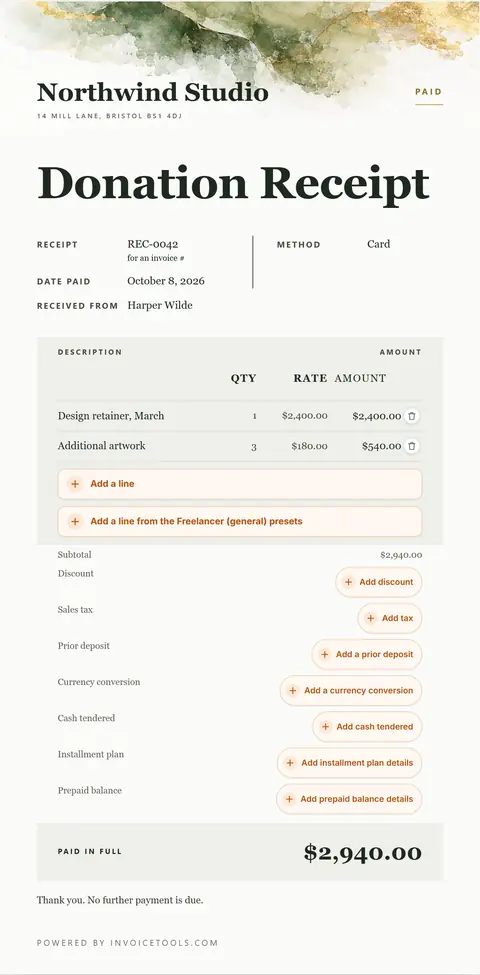
For a formal, editable version with a logo that you can send as a PDF, use the Donation Receipt design in the receipt maker. A free account is needed to open a design. The receipt maker itself needs none.
 Donation Receipt
A plain blank receipt is also available as Word, Excel or PDF. More layouts are on the receipt templates page, and the glossary defines a receipt.
Common mistakes
- Writing the value of donated property. The charity describes it only.
- Forgetting the benefit statement. "Thank you for your donation" is not enough. The receipt must say that nothing was received, or what was.
- Treating the whole payment as deductible when the donor got a meal, a ticket or merchandise.
- Collecting tax IDs for no reason. They are not needed on the receipt.
- Hiding the disclosure in small print. Pub 1771 says it must be written and likely to come to the donor's attention. Small print in a larger document might not do.
Sources
- IRS, charitable contributions: written acknowledgments, read 5 November 2026
- IRS Publication 1771, charitable contributions: substantiation and disclosure requirements ($250, $75, timing, penalty, no SSN, vehicles)
- Neon One, how to write donation receipts (read for comparison)
Common questions
What must a donation receipt include?
For the IRS, the written acknowledgment must have the charity's name, the amount of any cash contribution, a description (but not the value) of any property given, and a statement of whether the charity provided goods or services in return. If it did, it must describe them and give a good faith estimate of their value. If the only benefit was intangible religious benefits, it must say so.
Do I need a receipt for a donation under $250?
The IRS written acknowledgment rule starts at $250 for a single contribution. For smaller cash gifts, the donor needs a bank record or a written communication from the charity showing its name, the date and the amount. Many charities send a receipt for every gift anyway, because it is easy and it thanks the donor.
Does the charity put a value on donated property?
No. The acknowledgment describes the property but leaves its value to the donor. The charity must, however, state the value of any goods or services it gave in return for a gift.
When must the receipt be sent?
The donor needs it before claiming the deduction. Publication 1771 describes a timely written communication as one received on or before the earlier of the date the donor files the return or the return's due date, including extensions. In practice, send it within a few days of the gift and a year-end summary in January.
What is the $75 rule?
When a donor pays more than $75 and receives goods or services in exchange, such as a dinner at a fundraiser, the charity must give a written disclosure that says the deductible part is limited to the excess over the value received. The IRS penalty is $10 per contribution, up to $5,000 per fundraising event or mailing, unless there is reasonable cause.
Does the donor's Social Security number go on the receipt?
No. The IRS says it is not necessary to include the donor's Social Security number or tax identification number on the acknowledgment. Leave it off.
Can an email serve as the receipt?
Yes. The IRS says a written communication includes a receipt, a letter and an email. Keep a copy with the date it was sent.
Are donated cars, boats and planes handled the same way?
No. Publication 1771 says its rules do not apply to a donated motor vehicle, boat or airplane when the claimed value is over $500. Those have separate requirements, described in the IRS vehicle donation guide for charities.
What this is. A builder and guide written by InvoiceTools. It is general information, not tax or legal advice. IRS rules are as stated in Publication 1771 and the IRS acknowledgment page, read on 5 November 2026.
Last reviewed by InvoiceTools, Houston, Texas, on 5 November 2026.