The short version
A quote is a fixed price for named work, held open until a stated date. Write the scope and the exclusions carefully, put the deposit and the payment terms on it, and get it accepted in writing. When the job is done, the same document becomes the invoice. See where all six job documents fit together for the fuller picture, from estimate through receipt.
Quote, estimate or proposal
These three words get used for the same document and only one of them commits you to a price. A quote is fixed for the scope it describes. An estimate is your best assessment and may move. A proposal is a longer document that argues for the approach as well as the price.
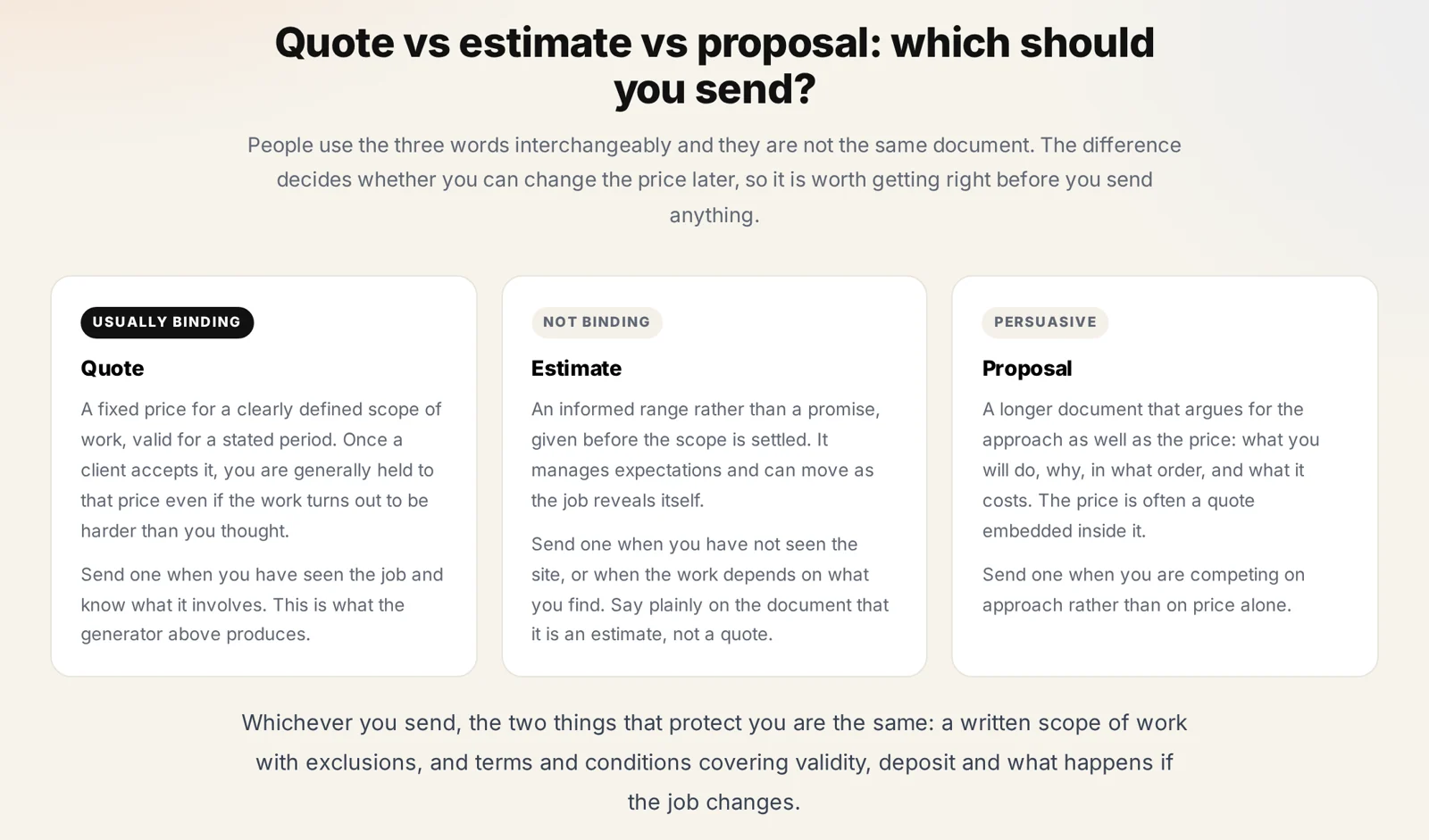
Send a quote when you can see the whole job. Send an estimate when you cannot, say so on the document, and state what happens when the scope turns out to be bigger. Calling an estimate a quote is how you end up doing extra work for free.
What goes on the quote
The number is the easy part. The scope is what decides whether the job is profitable, so write it as lines with quantities rather than as a paragraph, and write the exclusions as plainly as the inclusions. Anything you are not doing is worth one sentence now and an argument later.
Three things belong on every quote besides the price:
- A valid-until date, so an old price cannot be accepted six months later after your material costs have moved.
- The deposit, with what it covers and when it is due.
- The terms: the payment schedule, the late fee if you charge one, and the line that says work outside this quote is billed as a change order approved in writing before it starts.
If you are still working out what the job should cost you rather than what to charge, price it in the cost estimator first: materials with waste, labor hours, overhead, markup and contingency, section by section.
Starting from a description
The AI box takes the job in a sentence and drafts the quote from it, filling the fields it can and telling you which ones it could not.
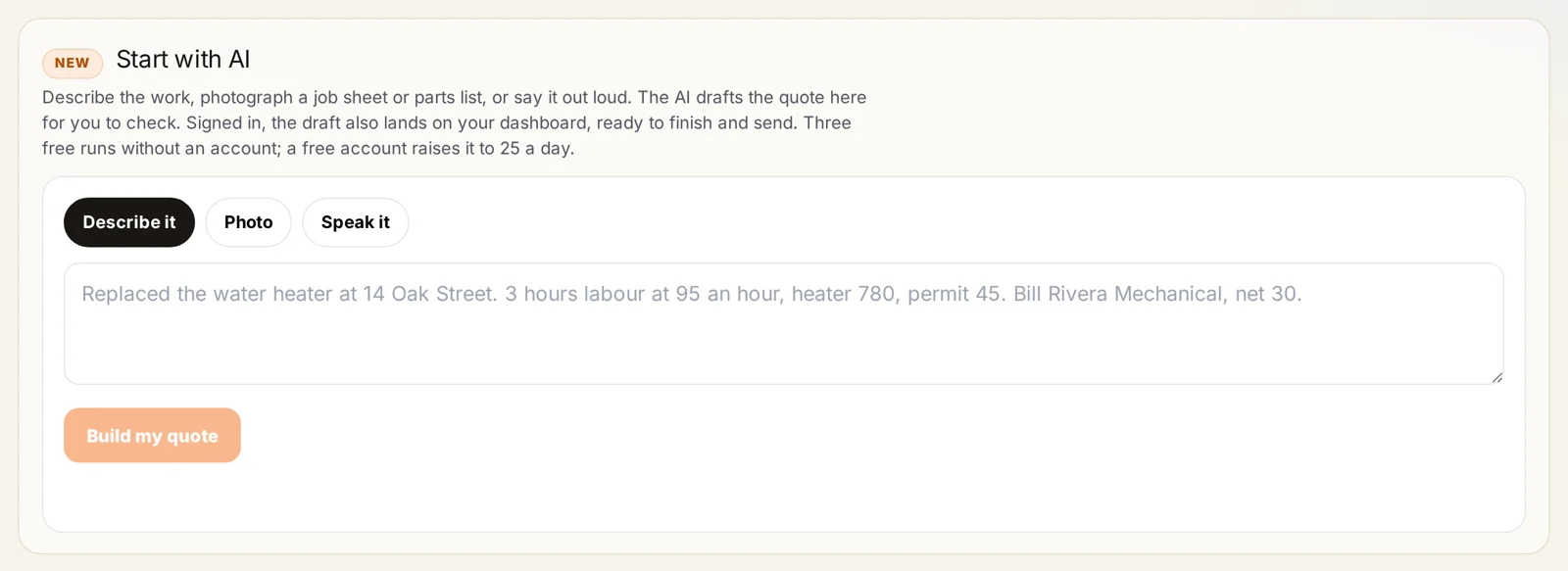
Treat what comes back as a first draft. Check the scope, the quantities and the price before it goes anywhere near a client, because a quote is an offer and you are bound by what it says.
Getting it accepted
Acceptance in writing is what turns a quote into an agreement, and it is what makes your terms enforceable later. An email that says yes is enough. A signature on the document is better, and it is what you will want if the job ends in a dispute.
Keep the accepted version. When a client later says the price included something, the accepted quote is the answer, which is also why the exclusions were worth writing.
Turning the quote into the invoice
Once the work is done, the invoice should carry the same lines, in the same order, at the same prices. Convert to Invoice does that: it moves the accepted lines across so you are not retyping them and not introducing a difference the client will spot.
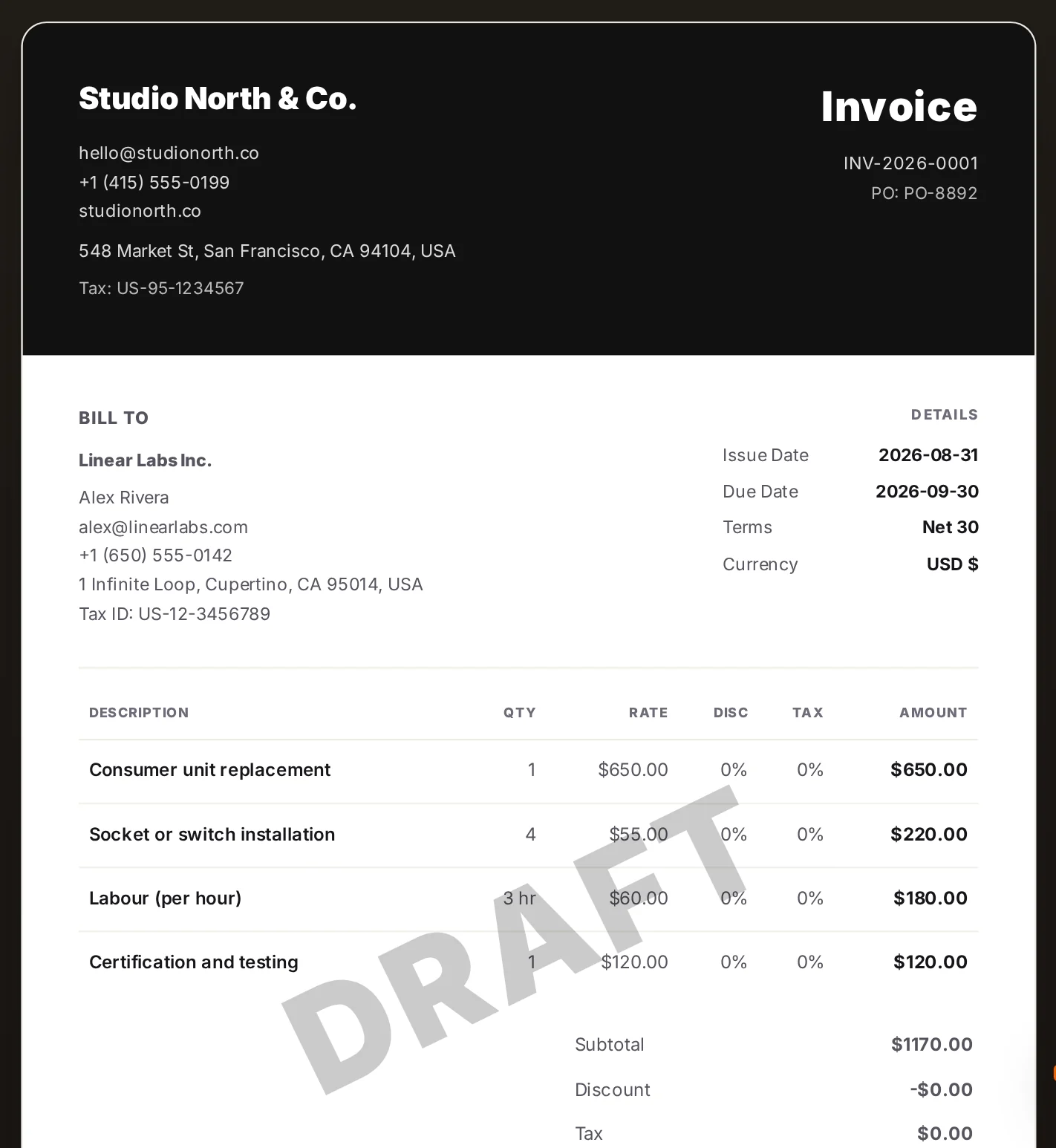
Two changes are normal between the two documents. Any approved change order appears as its own line with its number. And if a deposit was paid, name it and the amount on the invoice, then bill the balance. On a longer job the deposit is simply stage one of a progress billing schedule.
When the money arrives, send a receipt. It closes the job in the client's records as well as yours, and on a part payment it doubles as the reminder of what is left.
The tools for this
More guides
- Progress billing: format and exampleHow to bill a job in stages: the schedule of values, a worked progress invoice with retainage, pay applications and AIA forms, and the quote wording that gets each stage paid.
- How to chase an unpaid invoiceWhat to do when a client is not paying: the day-one reminder email, the day-seven call, the overdue notice with the late fee, the final demand letter, then liens, small claims and collections.
- How to write a change orderWhen to write a change order, what goes on the form, how to price extra work including time and materials, keeping a log, and how an approved change reaches the invoice.
- Deposit invoice: how to bill a depositWhen to ask for a deposit, how much, deposit versus down payment versus retainer, the wording on the quote and the deposit invoice, and how the final invoice shows the balance due.
- How to number invoices: format and examplesAn invoice numbering system that never repeats or skips, format examples with a year or job prefix, separate series for quotes and credit notes, and where the number goes on the invoice.
- How to make an invoiceA walkthrough of the invoice generator with a screenshot of each step: trade, client, lines, terms and the finished PDF.
- How to add a payment link and QR code to an invoiceBuild a payment link for PayPal, Venmo, Cash App, Zelle or ACH, put the QR on the document, and pick the right method for the job.
- Invoicing glossaryPlain definitions of the words on an invoice, a quote and a job, each with an example.
Common questions
What is the difference between a quote and an estimate?
A quote is a fixed price for the scope it describes and you are bound by it. An estimate is your best assessment and may move as the work is uncovered. Say which one you are sending on the document itself.
What should a quote include?
Your details and the client's, the scope as lines with quantities, the exclusions, the total, a valid-until date, the deposit, and the payment terms including how changes will be handled.
How long should a quote be valid?
Long enough for the client to decide and short enough that your material costs have not moved: 14 or 30 days suits most trade work. Put the date on the document rather than a number of days.
How do I turn a quote into an invoice?
Use Convert to Invoice on the accepted quote. The lines move across at the same prices, so the invoice matches the quote and you are not retyping anything.
Should I charge for writing a quote?
Not usually for a straightforward job, because quoting is part of winning work and is recovered through your overhead. A detailed survey or a design that the client could take elsewhere is different, and is worth pricing as its own small job.
What if the client asks for extra work after accepting?
Write it as a change order before you do it: the change in plain words, the price, the days it adds and the revised total. Approval comes first, then the work, then the line on the invoice.
Can I send an invoice without a quote?
Yes. An invoice does not need a quote before it to be valid. The quote settles the price before the work, so the invoice is not the first time the client sees the figure; on a small job agreed on the spot, a clear invoice on its own is enough.
What this is. A guide and template written by James Carter. It is not legal advice. Deposit, cancellation and late fee rules differ by state, so have any wording you rely on checked for your state before it goes on a real document.
Last reviewed by InvoiceTools, Houston, Texas, on 21 August 2026.