The short version
Send the first payment reminder the day after the due date, not a week later. Every message states the invoice number, the amount, the original due date and a way to pay. Add the late fee only if it was on the invoice the client accepted. Set a final date in writing, and when it passes, do the thing you said you would do. The templates below are the four messages, in order.
Before the invoice is overdue
Half of the chasing is avoided by the invoice itself. Send it the day the work finishes, addressed to the person who pays, with the client's PO number if they use one, the due date written as a date, and a payment link so paying takes one tap. On a large invoice, send a two-line check three days before the due date: "Is invoice 1041 in your system for payment on the 28th?" A wrong legal name or a missing PO surfaces now, while there is still time, instead of on day twelve.
Day one: the payment reminder email
The day after the due date, send a short message that assumes an oversight, because it usually is one. This is how to ask for payment politely without sounding like you are apologizing for asking: state the facts, attach the invoice again, repeat the payment link, and stop.
Subject: Invoice 1041, $2,450, was due 28 August
Hi Dana, a quick note that invoice 1041 for $2,450 was due yesterday. The invoice and the payment link are attached. If it has already gone out, ignore this. Thanks, Alex.
Nothing about fees yet, and nothing that needs a reply beyond payment.
Day seven: the phone call
If a week passes with no payment and no reply, call. Ask one question and wait for the answer: when will it be paid? Get a date and the name of the person who releases payment. Then send a one-line follow-up email the same day confirming what was said, so the date exists in writing.
If the call surfaces a problem with the work, treat it as a dispute rather than a late payment. Split the invoice: the disputed part is held while you sort it out, and the rest is due now. A client who owes $2,450 and disputes a $300 fitting owes $2,150 today.
Day fourteen: the overdue notice and the late fee
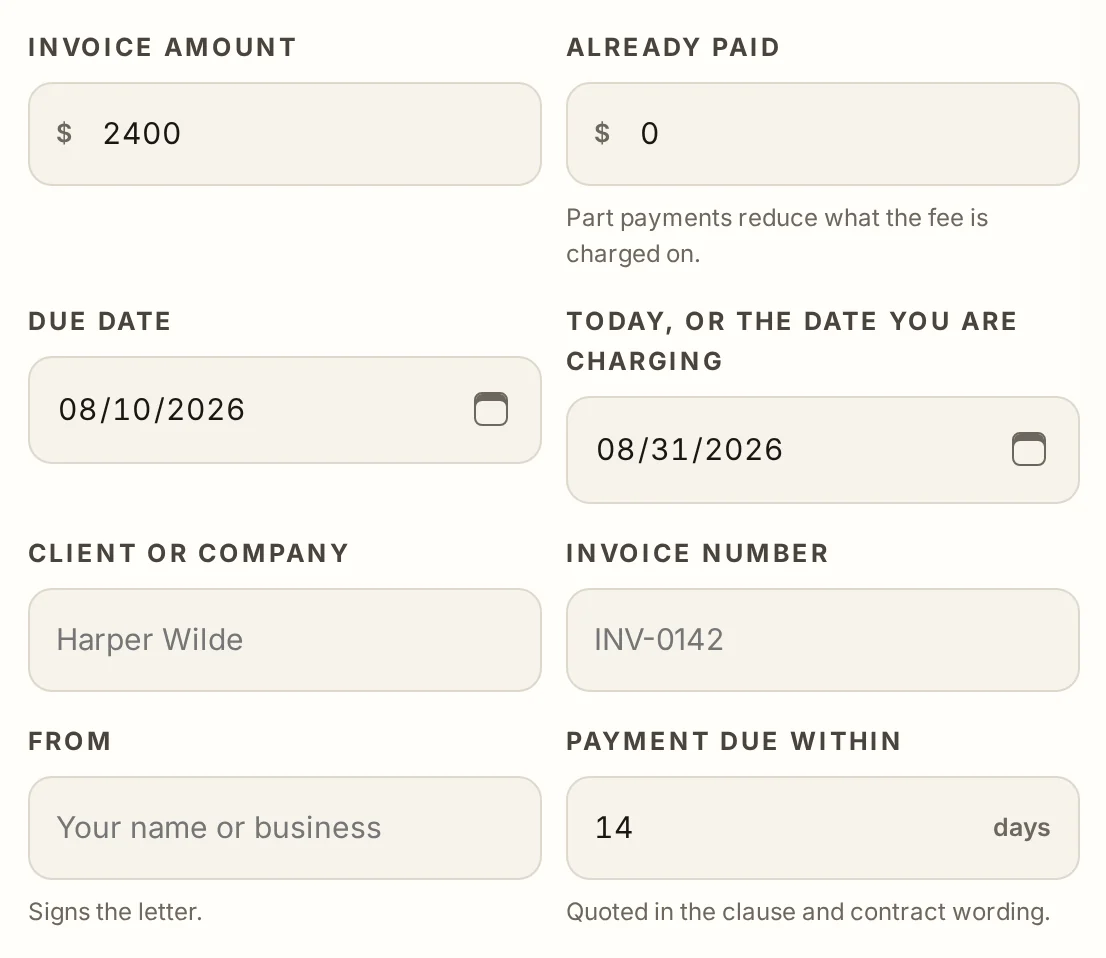
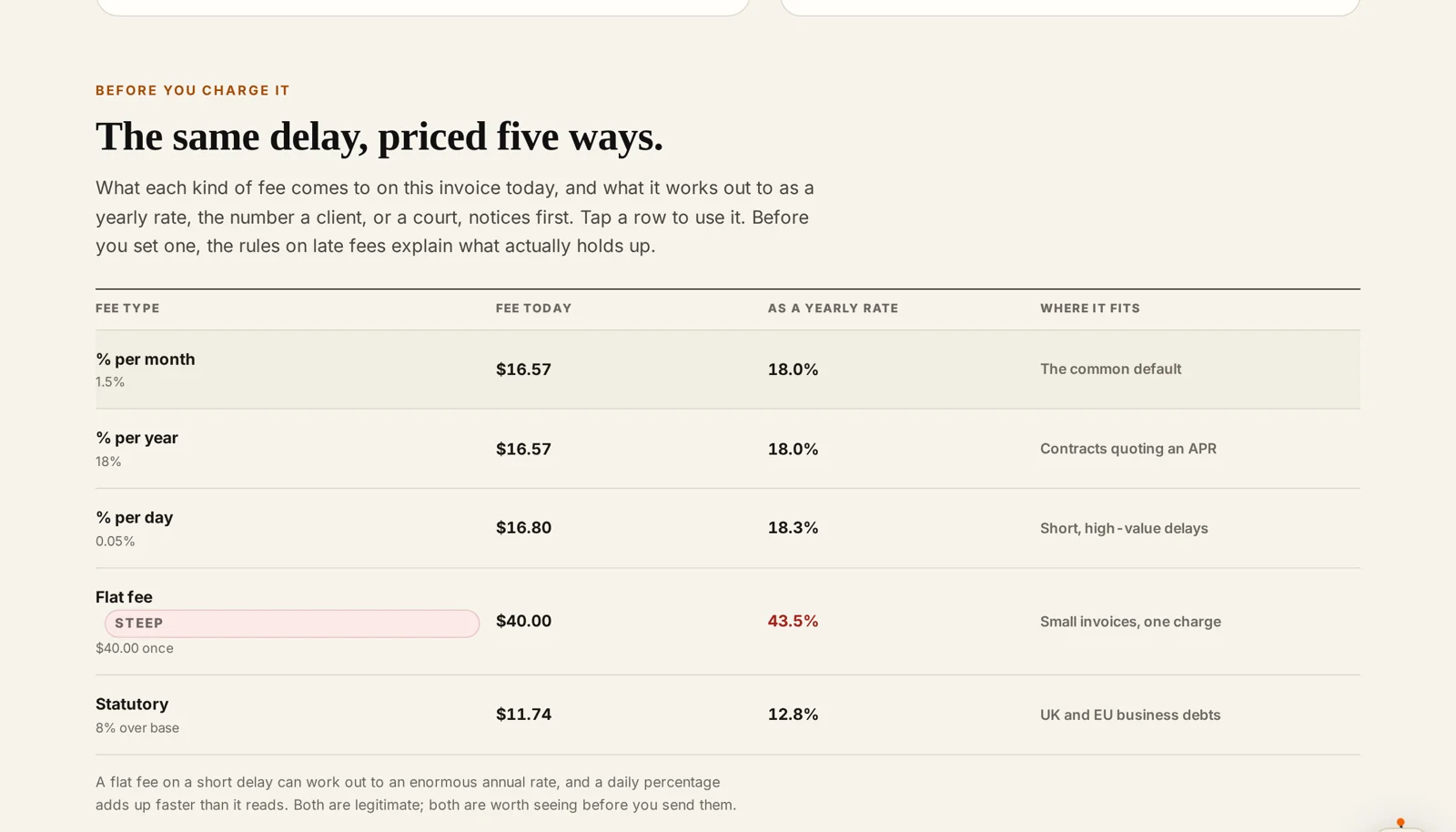
Two weeks past due, the tone changes from a reminder to an overdue invoice notice. It states the original amount, the late fee if one was on the invoice, the new balance, and what happens next. This is the letter the late fee generator or Invoice Due Date Calculator writes, with the interest worked out from the date and rate you set. Only charge a fee that was on the invoice or the accepted quote; the late fee laws page explains what is enforceable and what your state allows.
Subject: Overdue notice, invoice 1041
Invoice 1041 for $2,450 was due on 28 August and remains unpaid. As stated on the invoice, a late fee of 1.5% per month applies to overdue balances, so the amount now due is $2,486.75. Please pay by 18 September. If payment is not received by then I will pass the account to collections, and no further work will be scheduled until it is settled.
Day thirty: the final demand letter
The final demand letter is one paragraph: the total, a date, and the one action you will take after it. Name only an action you will take. A threat that is not carried out tells the client the next one is empty too.
Subject: Final demand, invoice 1041
Invoice 1041, now $2,486.75 including the late fee stated on it, has been unpaid for 30 days. If it is not paid by 25 September I will file a claim in small claims court for the amount owed plus the filing fee. This is the last notice before that happens.
After the final date: liens, small claims and collections
When the date passes with no payment and no agreed plan, the options, roughly in the order they cost you:
- Stop scheduling work for the client until the account is settled. Check your contract for a right to suspend.
- Small claims court. Filing is cheap and you can represent yourself; the claim limit differs by state.
- A mechanics lien on the property, if the work was construction or a permanent improvement. Lien deadlines are short and differ by state, so check yours before day thirty rather than after.
- A collections agency, which keeps a share of whatever it recovers.
- Write it off, and do not work for the client again.
There is also a clock on all of this. Every state sets a statute of limitations for suing over an unpaid invoice, and it is usually longer for a written agreement than for a verbal one. An accepted quote and a signed work order are what make yours the written kind. Whichever option you pick, keep the whole sequence in one email thread, so the dates and the amounts are in one place if anyone else ever needs to read it.
What not to do when a client is not paying
Do not go quiet for three weeks and then send an angry message; the gap is what the client remembers. Do not knock money off to close it unless you have decided that 90% today is worth more to you than 100% next month, which is a decision, not a reflex. Do not keep taking work from a client with two unpaid invoices. And do not resend an invoice with a changed number or date, because the client's accounts team will treat it as a new document and the clock starts again.
Stopping the next unpaid invoice
The invoices that never need chasing share three things: a deposit so the client has paid before the work starts, terms on the quote that the client agreed to, and a payment link on the document. For longer jobs, progress billing puts a due date on each stage instead of one at the end. The late payment statistics show what the wait costs when none of this is in place.
If chasing feels constant rather than occasional, look past the single invoice: the DSO calculator turns every invoice you are owed on into one number, the average days it actually takes to get paid, so you can tell whether it is one slow client or your terms across the board.
The tools for this
More guides
- Progress billing: format and exampleHow to bill a job in stages: the schedule of values, a worked progress invoice with retainage, pay applications and AIA forms, and the quote wording that gets each stage paid.
- How to write a change orderWhen to write a change order, what goes on the form, how to price extra work including time and materials, keeping a log, and how an approved change reaches the invoice.
- Deposit invoice: how to bill a depositWhen to ask for a deposit, how much, deposit versus down payment versus retainer, the wording on the quote and the deposit invoice, and how the final invoice shows the balance due.
- How to number invoices: format and examplesAn invoice numbering system that never repeats or skips, format examples with a year or job prefix, separate series for quotes and credit notes, and where the number goes on the invoice.
- How to make an invoiceA walkthrough of the invoice generator with a screenshot of each step: trade, client, lines, terms and the finished PDF.
- How to add a payment link and QR code to an invoiceBuild a payment link for PayPal, Venmo, Cash App, Zelle or ACH, put the QR on the document, and pick the right method for the job.
- Quote to invoiceWhat goes on a quote, quote versus estimate, setting the deposit and validity, and converting the accepted quote into an invoice.
- Invoicing glossaryPlain definitions of the words on an invoice, a quote and a job, each with an example.
Common questions
How long should I wait before chasing an unpaid invoice?
One day. Send a short payment reminder the day after the due date, call after a week, send an overdue notice after two weeks and a final demand at thirty days. Each step is easier to take when the previous one happened on time.
How do I politely ask a client to pay an invoice?
State the facts in three or four sentences: the invoice number, the amount, the original due date and a way to pay. Attach the invoice again, assume an oversight, and do not mention fees in the first reminder. Polite is short and specific, not apologetic.
What should an overdue invoice reminder say?
The invoice number, the amount, the original due date and a way to pay. The first reminder assumes an oversight. The notice two weeks later adds the late fee if one was on the invoice, the new balance and what happens next.
Can I charge a late fee on an unpaid invoice?
Only if the fee was stated on the invoice or the quote the client accepted before the work started. A fee that first appears on the reminder is hard to enforce. The late fee generator works out the balance from the rate and date you set.
Can I stop work if an invoice is unpaid?
Usually yes for future work, and for work in progress if your contract gives you the right to suspend. Say it in writing with a date, and do it on that date rather than threatening it twice.
Should I offer a discount to settle an overdue invoice?
Only as a decision, not a reflex. A discount closes the account faster but teaches the client that late payment earns a lower price. If you offer one, make it a one-time offer with a date attached.
Is there a time limit for collecting an unpaid invoice?
Yes. Every state sets a statute of limitations for suing over an unpaid debt, and it is usually longer for a written agreement than for a verbal one. An accepted quote or a signed work order makes yours the written kind. Act well inside the limit rather than near it.
When should I take an unpaid invoice to small claims court?
After the final demand date has passed with no payment and no agreed plan. Claim limits and filing fees differ by state, and you can represent yourself. Bring the quote, the invoice and the email thread.
What this is. A guide and template written by Emily Johnson. It is not legal advice. Deposit, cancellation and late fee rules differ by state, so have any wording you rely on checked for your state before it goes on a real document.
Last reviewed by InvoiceTools, Houston, Texas, on 18 August 2026.