The short version
An invoice number is a unique reference that runs in sequence. Pick a format, use it on every invoice, never repeat a number and never delete one: a canceled invoice keeps its number and is marked void. Quotes, purchase orders and credit notes each get their own series. The number goes at the top of the invoice, in the PDF filename and in the email subject.
Why the invoice number matters
The client's accounts team pays by invoice number, not by job or by your name. Their remittance advice quotes it, their software rejects a second invoice with the same number as a duplicate, and their query about a payment starts with it. On your side, an unbroken sequence is the first thing an accountant or an auditor checks, because a missing number needs an explanation and a repeated one needs two. No US rule prescribes an invoice number format, but every tax and audit conversation assumes the sequence exists.
Invoice number format examples
- Sequential invoice numbers: 1001, 1002, 1003. The simplest invoice numbering system, and enough for most businesses. Starting above 1 is common and costs nothing.
- Year prefix: 2026-0041. Shows the year at a glance and resets each January. Pad the count so files sort in order.
- Client prefix: ACME-0007. One series per client, which suits a few large clients and gets unwieldy past a dozen.
- Job based: 26-031-2, the job number then the invoice within the job. Suits staged jobs, where the second invoice on job 31 says so in its number.
- Letter prefix: INV-2026-0041. The same as the year format with a label that says what the document is, useful when quotes and orders sit in the same folder.
Whatever you choose, keep it short enough to read out on the phone and wide enough to sort: 0041 sorts before 0102, but 41 sorts after 102 in a folder. A date on its own, such as 20260830, fails the first time you send two invoices in one day. If in doubt, a year prefix and a padded count covers almost everyone.
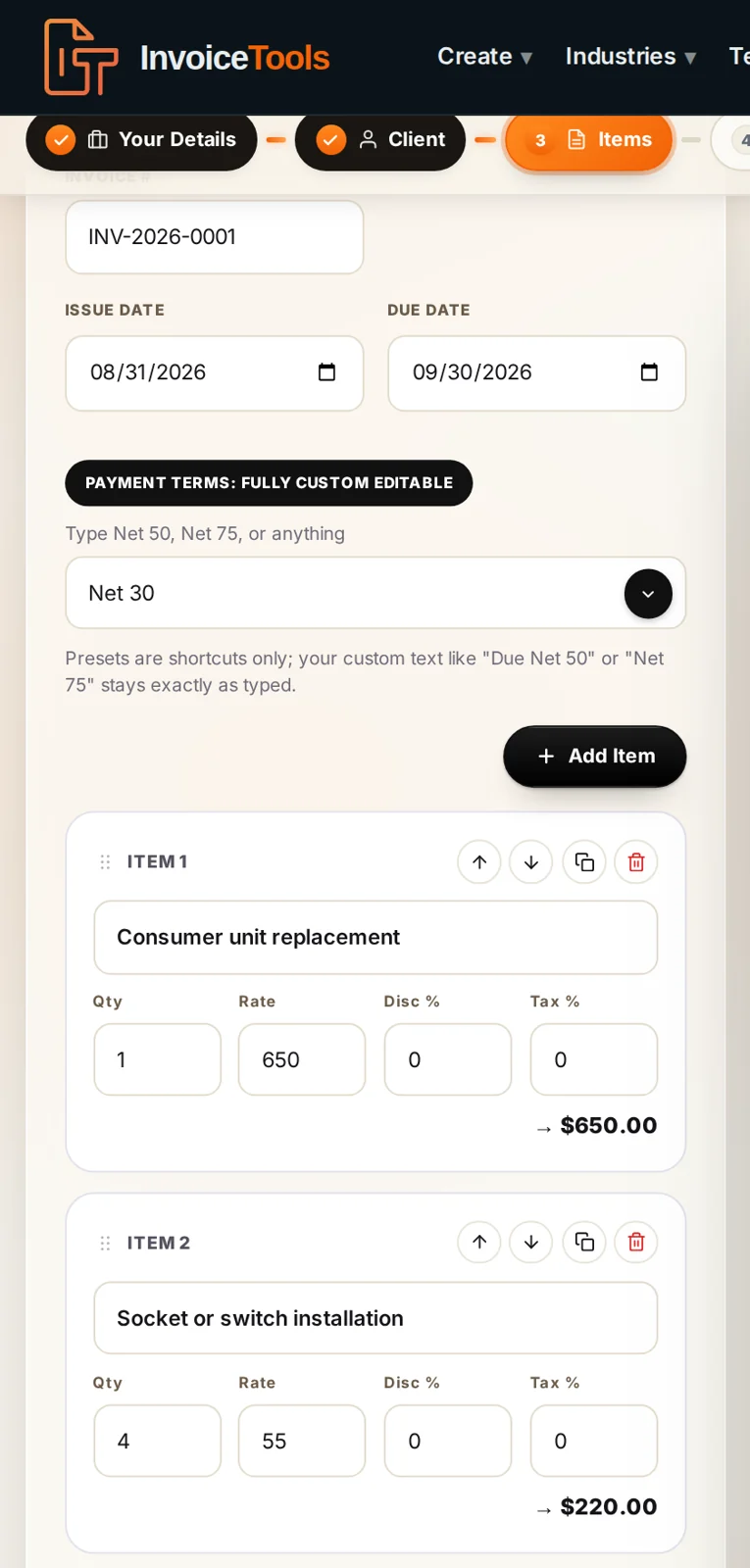
Quotes, purchase orders and credit notes get their own series
A quote is not an invoice and should not use up an invoice number. Give quotes and estimates a Q or EST series, purchase orders a PO series, work orders a WO series and credit notes a CN series. Deposit invoices stay in the invoice series, because they are invoices. Receipts carry the number of the invoice they settle, so there is nothing new to track. The quote generator, purchase order generator and work order each keep their own numbering, and the invoice generator suggests the next invoice number automatically.
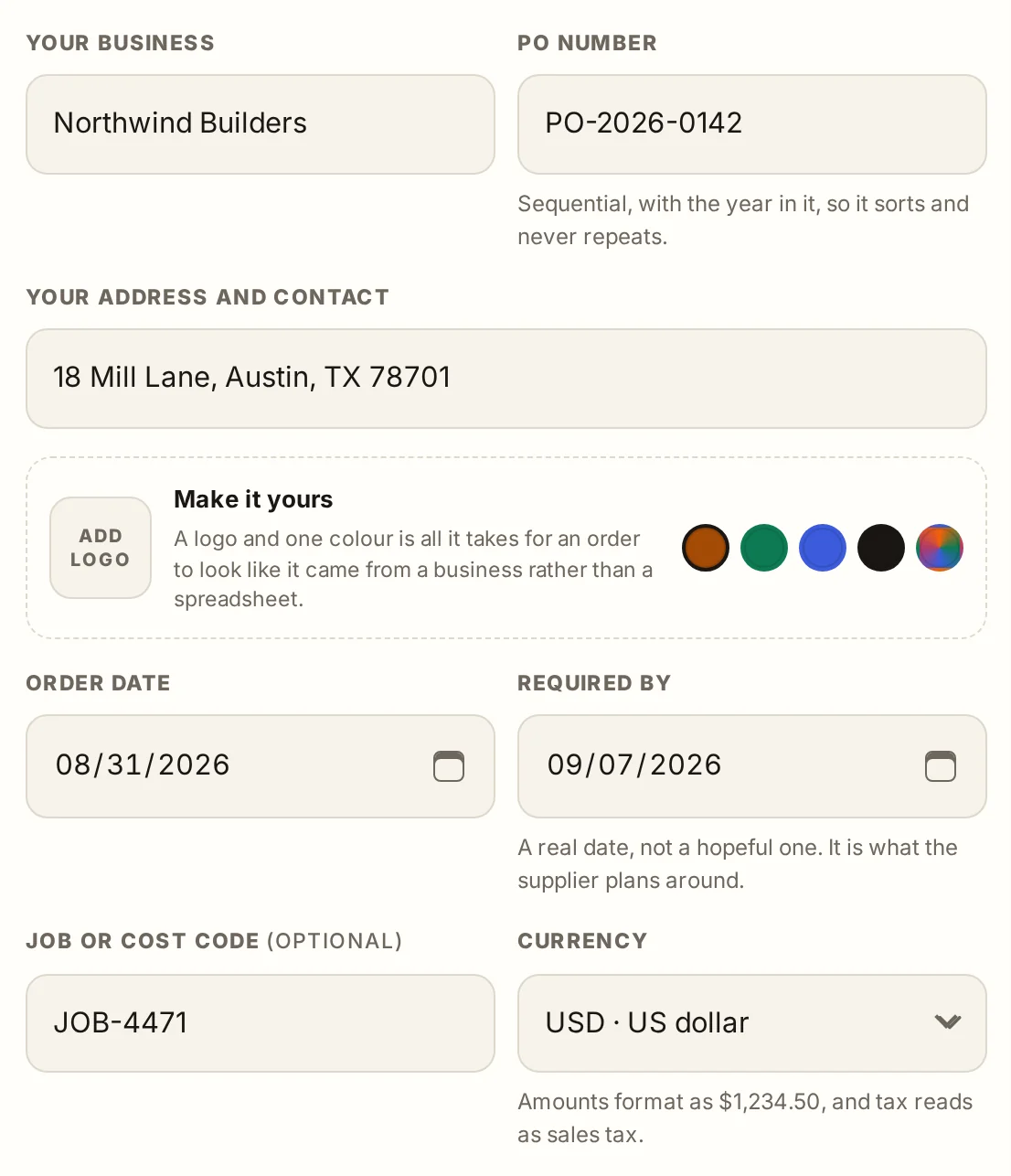
Voids, corrections and credit notes
A mistake caught before sending is edited on the same number. A mistake caught after sending is not: the sent invoice keeps its number and is marked void, and a corrected invoice goes out with the next number and a line that says which one it replaces. An overcharge on an invoice the client has already paid is fixed with a credit note in its own series, referring to the invoice number, and never by deleting or editing the original. Deleting an invoice is the one thing that turns a tidy sequence into a question.
Starting a numbering system, or switching
Start today with the next number in whatever series you have, even if the last one was handwritten. If you are changing format, change it on 1 January with a fresh series and leave the old numbers alone; renumbering old invoices breaks every reference the client already holds. Most invoicing software numbers automatically and lets you set the starting number, so set it to the next one in your existing series rather than letting it start again at 1. Signed in, the invoice generator fills in the next number from your last one. Signed out, it suggests a number in the INV-2026-0001 pattern and you overwrite it with your own.
Where the invoice number goes
At the top of the invoice next to the date, where the client's accounts team looks first. In the PDF filename, so a folder of invoices sorts itself: Invoice-2026-0041-Acme.pdf. In the email subject with the amount and the due date, so the invoice can be found in an inbox months later. And as the payment reference, so the line on your bank statement matches the invoice without a phone call. The payment link generator puts the invoice number on the link for that reason.
The tools for this
More guides
- Progress billing: format and exampleHow to bill a job in stages: the schedule of values, a worked progress invoice with retainage, pay applications and AIA forms, and the quote wording that gets each stage paid.
- How to chase an unpaid invoiceWhat to do when a client is not paying: the day-one reminder email, the day-seven call, the overdue notice with the late fee, the final demand letter, then liens, small claims and collections.
- How to write a change orderWhen to write a change order, what goes on the form, how to price extra work including time and materials, keeping a log, and how an approved change reaches the invoice.
- Deposit invoice: how to bill a depositWhen to ask for a deposit, how much, deposit versus down payment versus retainer, the wording on the quote and the deposit invoice, and how the final invoice shows the balance due.
- How to make an invoiceA walkthrough of the invoice generator with a screenshot of each step: trade, client, lines, terms and the finished PDF.
- How to add a payment link and QR code to an invoiceBuild a payment link for PayPal, Venmo, Cash App, Zelle or ACH, put the QR on the document, and pick the right method for the job.
- Quote to invoiceWhat goes on a quote, quote versus estimate, setting the deposit and validity, and converting the accepted quote into an invoice.
- Invoicing glossaryPlain definitions of the words on an invoice, a quote and a job, each with an example.
Common questions
What is an invoice number?
A unique reference that identifies one invoice and runs in sequence with the ones before it. The client pays by it, and your records rely on the sequence being unbroken.
What is the best invoice numbering system for a small business?
A year prefix and a padded running count, such as 2026-0041, covers almost everyone: it sorts correctly, shows the year at a glance and never repeats. Plain sequential numbers work if you send few invoices, and a job-based number suits staged jobs.
Do invoice numbers have to be sequential?
No US rule prescribes a format, but a sequence with no gaps is what accountants and auditors expect, because a missing number needs an explanation. Sequential numbering is the simplest way to show that nothing is missing.
Can I start invoice numbers at 1000?
Yes. Any starting point works as long as the numbers run in order from there. Starting above 1 is common and costs nothing.
What happens if I skip an invoice number?
Nothing, provided you can explain the gap. Note the skipped number as void in your records so the sequence still accounts for every number.
Can two invoices have the same number?
No. The client's accounts software will reject the second one as a duplicate, and your own records cannot tell them apart. A corrected invoice gets the next number and refers to the one it replaces.
Can I change my invoice numbering system?
Yes, on a clean break such as 1 January: start a fresh series and leave the old numbers alone. Renumbering old invoices breaks every reference the client already holds.
Should quotes and invoices share a number series?
No. A quote that is never accepted would leave a gap in the invoice sequence. Give quotes, purchase orders, work orders and credit notes their own series and keep the invoice series for invoices, including deposit invoices.
What this is. A guide and template written by Emily Johnson. It is not legal advice. Deposit, cancellation and late fee rules differ by state, so have any wording you rely on checked for your state before it goes on a real document.
Last reviewed by InvoiceTools, Houston, Texas, on 2 August 2026.