The short version
A deposit invoice bills the agreed part of the price upfront, before the work starts. It refers to the accepted quote, says what the deposit covers and when the balance is due, and is followed by a receipt once it is paid. The final invoice bills the balance due and names the deposit invoice, so the client sees the whole job across two documents that match.
When to ask for a deposit
Ask for a deposit when you buy materials before the first day on site, when you order anything custom or non-returnable, when the job blocks out your calendar for more than a few days, and when the client is new. The question is what it would cost you if the job were canceled the night before it started. If the answer is more than an afternoon, take a deposit.
Skip it for small repeat jobs for clients who have paid on time before. A deposit invoice on a two-hour call-out is paperwork for its own sake.
How much deposit to ask for
Tie the amount to what you spend before you start. Add up the materials, any non-returnable orders and the first few days of labor, and that is the deposit. On a $15,000 kitchen where the cabinets and countertop cost $6,000, a $6,000 deposit covers the order; $7,500 covers the order and the first days on site. A round percentage is fine as long as it lands near that number: a 50% deposit is common on jobs where materials are a big share of the price, and 25% to 30% where labor is.
Check the cap for your state first. California limits the down payment on a home improvement contract to $1,000 or 10% of the contract price, whichever is less, with no exception for special-order materials, and every payment after that is limited to the value of the work done and materials delivered. Other states set their own rules for home improvement work, and your state's contractor licensing board publishes them. Commercial and business-to-business work is usually not capped, so the deposit there is whatever the client accepts on the quote.
Deposit, down payment or retainer
Three words that get used for the same thing, and one of them is different. A deposit is part of the price paid before the work, credited against the balance at the end. A down payment is the same thing under the name consumer contracts and state statutes use, which is why California's cap talks about a down payment. A retainer is money paid in advance to hold your availability or to draw against for ongoing work, such as a lawyer's or a consultant's hours; it is drawn down as the work is done and topped up, and it belongs on a recurring invoice rather than a one-off deposit invoice. Use the word the client's paperwork uses, and make the quote say which one you mean.
The deposit line on the quote
The deposit is its own line on the quote, with the amount, what it covers, when it is due, and what happens when it clears.
Deposit: $6,000, due on acceptance. Covers the cabinets, countertop and fixtures ordered on your behalf. The start date is booked once the deposit is received. Balance of $9,000 due within 7 days of completion.
The quote generator has a deposit field for this, and a valid-until date, so the price and the deposit expire together if the client sits on it.
Deposit invoice example
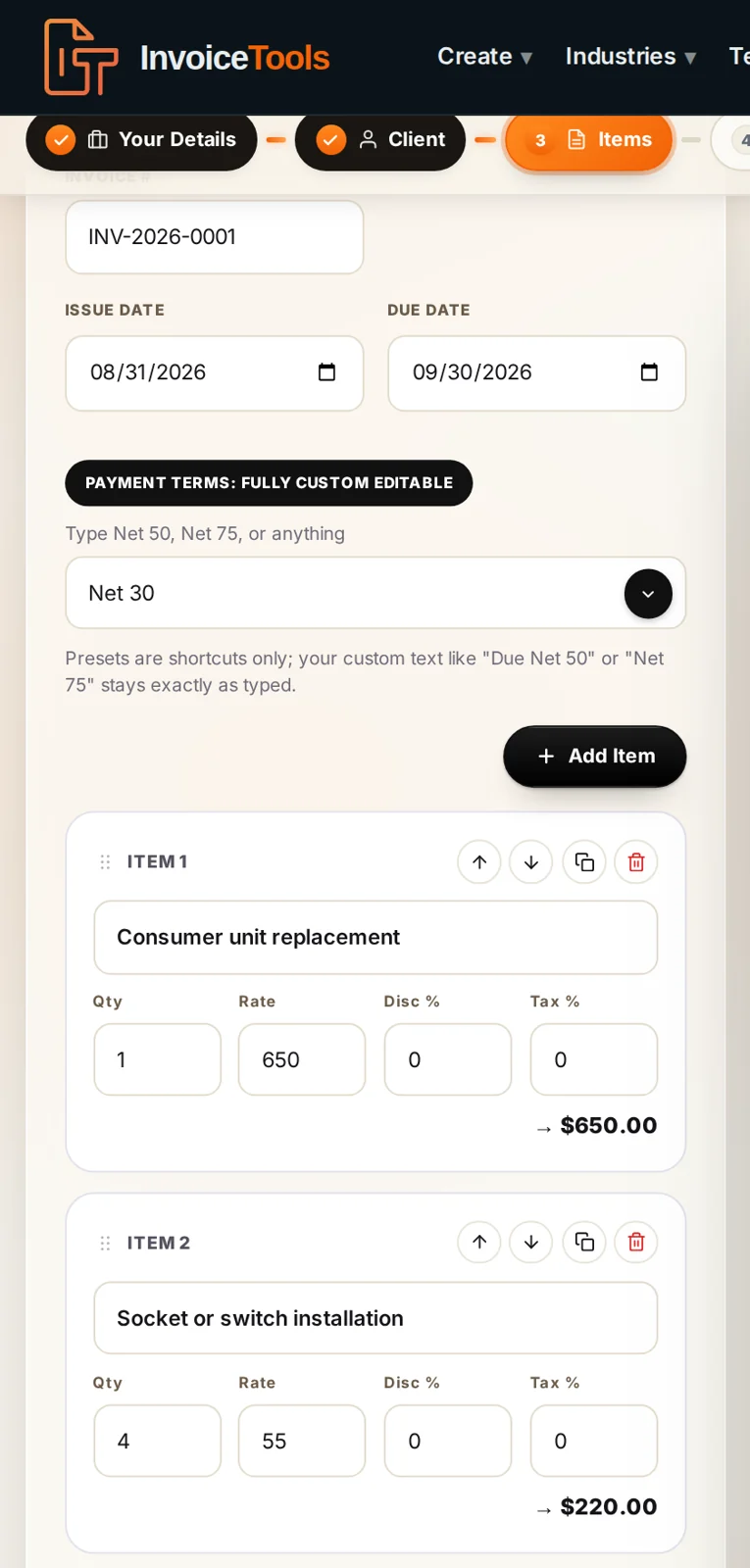
Once the quote is accepted, send the deposit invoice the same day, with the quote attached. It is an invoice like any other: a number in your normal series, the date, the client's details, one line that says what it is, the due date, and a payment link so it can be paid before the client closes the email.
Invoice 1041. Deposit against quote Q-1042, kitchen remodel at 118 Elm Street. $6,000, due on receipt. Balance of $9,000 will be invoiced on completion.
Book the start date when the money clears, not when the invoice is sent. A deposit that has not arrived is a quote that has not been accepted yet.
Refundable or non-refundable
Decide before the quote goes out and write it down, because the question only ever comes up after a cancellation. A common position: the deposit is refundable in full until the materials are ordered, and after that you refund what you have not spent and keep the cost of anything ordered on the client's behalf that cannot be returned. A fully non-refundable deposit is harder to hold onto than the sentence suggests, because what you can keep also depends on your contract and your state's consumer rules. The sentence on the quote is what you will be held to.
The deposit is refundable in full until materials are ordered. After that, cancellation is refunded less the cost of any non-returnable items ordered for this job.
The deposit receipt
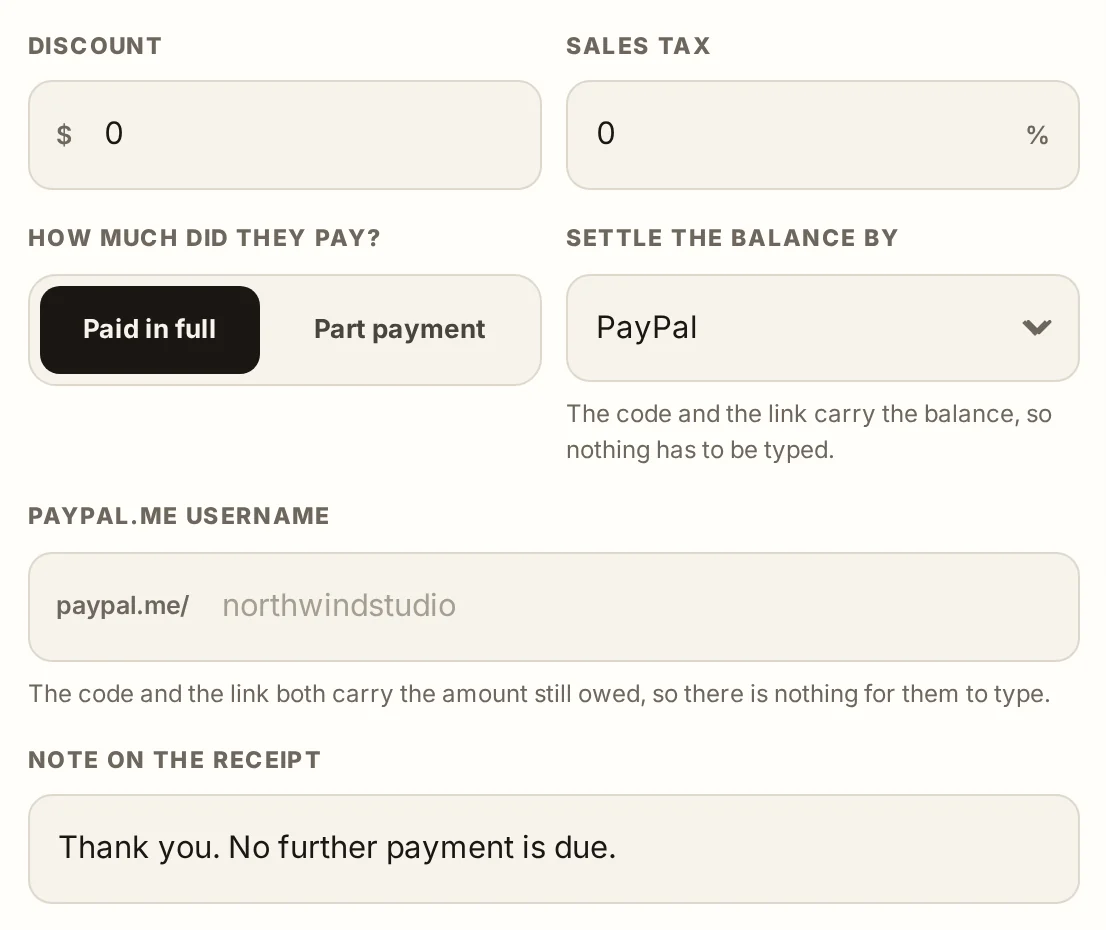
When the deposit lands, send a receipt: what it was for, the amount, how it was paid, the date, and the balance still to come. The receipt maker builds a deposit receipt with the balance shown, so the client has proof of payment and a reminder of what is left in one document.
Billing the balance due
The final invoice lists the work, then states what has already been paid, so the client can see the whole job:
Deposit invoice 1041 paid 4 September: $6,000. This invoice bills the balance due of $9,000.
If your invoicing tool has no line for a partial payment already received, put that sentence in the terms and bill only the balance as the line items. The accepted quote, the deposit invoice and the final invoice then add up on their own. On a longer job, the deposit is stage one of a progress billing schedule and every later invoice shows it under "billed on earlier invoices".
The tools for this
More guides
- Progress billing: format and exampleHow to bill a job in stages: the schedule of values, a worked progress invoice with retainage, pay applications and AIA forms, and the quote wording that gets each stage paid.
- How to chase an unpaid invoiceWhat to do when a client is not paying: the day-one reminder email, the day-seven call, the overdue notice with the late fee, the final demand letter, then liens, small claims and collections.
- How to write a change orderWhen to write a change order, what goes on the form, how to price extra work including time and materials, keeping a log, and how an approved change reaches the invoice.
- How to number invoices: format and examplesAn invoice numbering system that never repeats or skips, format examples with a year or job prefix, separate series for quotes and credit notes, and where the number goes on the invoice.
- How to make an invoiceA walkthrough of the invoice generator with a screenshot of each step: trade, client, lines, terms and the finished PDF.
- How to add a payment link and QR code to an invoiceBuild a payment link for PayPal, Venmo, Cash App, Zelle or ACH, put the QR on the document, and pick the right method for the job.
- Quote to invoiceWhat goes on a quote, quote versus estimate, setting the deposit and validity, and converting the accepted quote into an invoice.
- Invoicing glossaryPlain definitions of the words on an invoice, a quote and a job, each with an example.
Common questions
What is a deposit invoice?
An invoice for the agreed part of the price that is paid before the work starts. It refers to the accepted quote, states what the deposit covers and when the balance is due, and is followed by a receipt once paid.
How much deposit should a contractor ask for?
Enough to cover what you spend before the first day on site: materials, non-returnable orders and the first few days of labor. A round 30% or 50% is fine if it lands near that figure, and some states cap deposits on home improvement work, so check your state's rules first.
Is a 50% deposit normal for a contractor?
It is common on jobs where materials are a big share of the price and on custom work, and 25% to 30% is common where labor is the bigger share. Some states cap deposits on home improvement contracts with homeowners, so check the rule for your state before you set a number.
What is the difference between a deposit and a retainer?
A deposit is part of the price paid before the work and credited against the final balance. A retainer is money paid in advance to hold your availability or to draw against for ongoing work, topped up as it is used. A down payment is the consumer-contract name for a deposit.
Are contractor deposits capped by law?
In some states, for home improvement contracts with homeowners. California caps the down payment at $1,000 or 10% of the contract price, whichever is less. Commercial work is usually not capped. Your state's contractor licensing board publishes the rule that applies to you.
Can I keep a deposit if the client cancels?
Only what your quote says you can keep, within your state's consumer rules. A common position is a full refund until materials are ordered, then a refund less the cost of non-returnable items. Write it on the quote before the work starts.
Should I send a receipt for a deposit?
Yes, the day it arrives. The receipt shows what the deposit was for, the amount, how it was paid and the balance still to come. It is the client's proof of payment and your record that the start date is booked.
How do I show a deposit on the final invoice?
Name the deposit invoice and the amount paid on the final invoice, then bill the balance due. If your tool has no line for a partial payment received, put the sentence in the terms and list only the balance as line items.
What this is. A guide and template written by Michael Reed. It is not legal advice. Deposit, cancellation and late fee rules differ by state, so have any wording you rely on checked for your state before it goes on a real document.
Last reviewed by InvoiceTools, Houston, Texas, on 4 September 2026.