The short version
Progress billing is invoicing one job in stages as they are completed, instead of one invoice at the end. The stages and their dollar values are agreed on the quote as a schedule of values. Every progress invoice shows the whole contract, what was billed before, what is billed now, any retainage held, and what is left. Each stage is invoiced the day it is reached.
When to use progress billing
Use progress billing when you carry the cost of the job for longer than one pay cycle. That covers any job that runs past two or three weeks, any job where you buy the materials before the first day on site, and any job with subcontractors who will invoice you before the client pays. It also covers jobs financed by a lender, because the lender releases money against work done and will expect a progress invoice that shows it. Contractors call the same thing milestone billing, installment billing or stage payments; the paperwork is the same.
A short job for a known client does not need it. One invoice on completion, due on receipt, is less paperwork for both sides. The payment terms guide explains that choice.
The schedule of values
The stages live on the quote, not the invoice. Break the contract price into named stages with a dollar value each, adding up to the full price. That list is the schedule of values, and every progress invoice refers back to it. Two ways to cut it:
- By milestone: a stage ends when something the client can see is finished, such as rough-in passed inspection or tile complete. Suits remodels, installs and anything under a few months.
- By percentage of completion: an invoice at the end of each month for the percentage of each line completed that month. Suits long jobs and commercial work, where the client's accounts run on a monthly cycle and the pay application is expected on a set date.
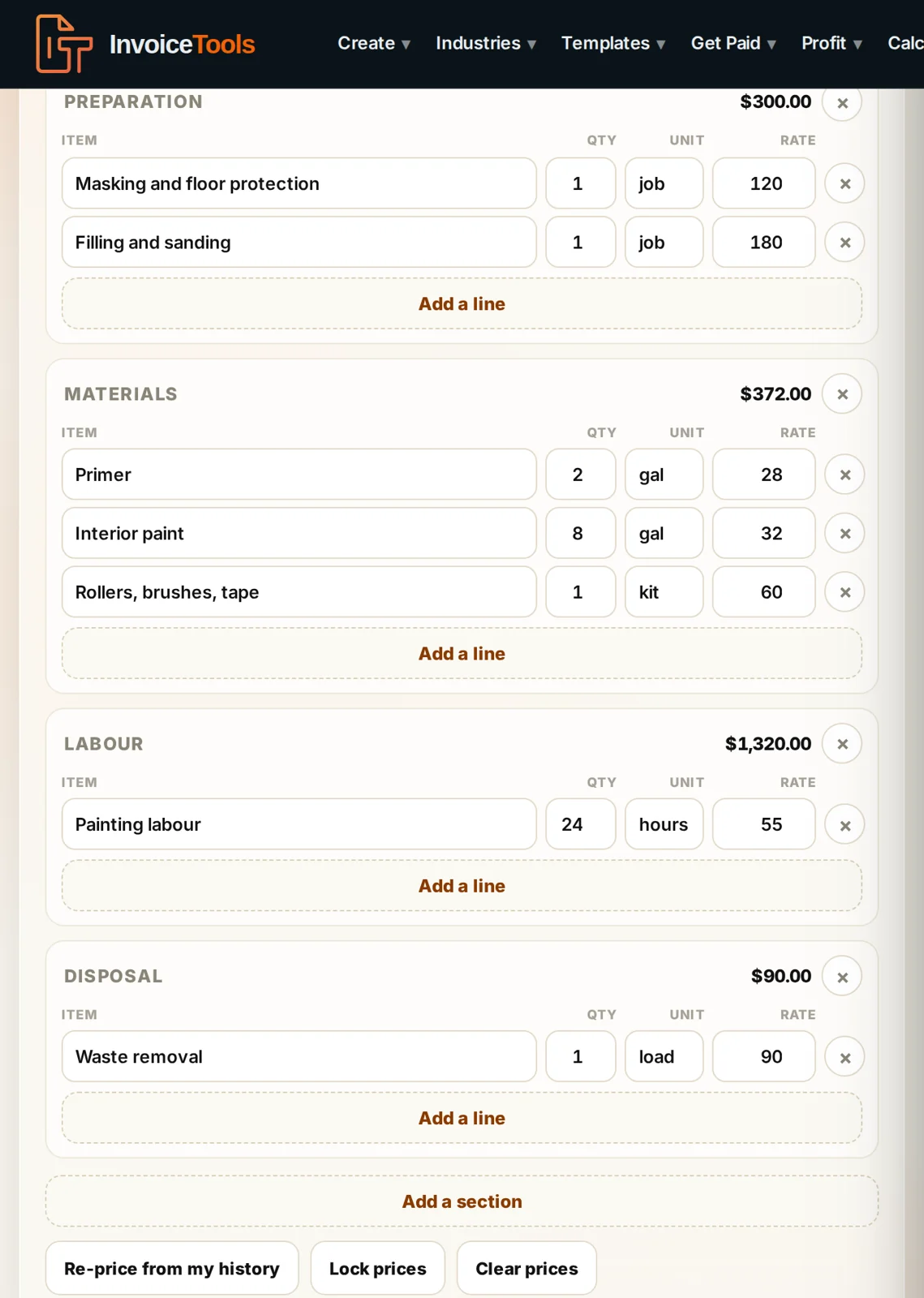
A milestone schedule of values for an $18,400 bathroom remodel might read:
| Deposit at signing | $1,840 |
| Demolition and rough-in complete | $5,520 |
| Tile, fixtures and drywall complete | $7,360 |
| Paint, fittings and walkthrough | $3,680 |
| Contract sum | $18,400 |
Two rules for the schedule. Each stage should be worth at least what it costs you to reach it, so you are never funding the client. And the last stage should be small enough that a client who holds it back over a punch list is holding back a nuisance, not your margin.
One check before you send it: some states cap the deposit on home improvement work for homeowners. California limits it to $1,000 or 10% of the contract price, whichever is less, and progress payments after that cannot exceed the value of the work done. The $1,840 deposit above would have to be $1,000 there. Your state's contractor licensing board will say what applies to you.
Progress invoice example
A progress invoice is not a normal invoice with a smaller number on it. It shows the client where this progress payment sits in the whole job, which is what stops the phone call asking what the last one was for. The second invoice on the remodel above, after a $900 change order for an extra outlet and a vent fan, looks like this:
| Revised contract sum (with change order 1) | $19,300 |
| Billed on earlier invoices | $1,840 |
| This stage: demolition and rough-in, plus change order 1 | $6,420 |
| Retainage held, 10% of this stage | $642 |
| Due on this invoice | $5,778 |
| Left to bill after this invoice | $11,040 |
Every number on it can be checked against the quote and the previous invoice. Give each stage its own invoice number in your normal series, put the job number on all of them, and attach the proof for the stage: the inspection card, or two photos.
Retainage on a progress invoice
Retainage is a slice of each progress payment, usually 5 or 10 percent, that the client holds back until the job is accepted. The contract sets it, and some states cap it. It is common on commercial work and rare on residential work unless a lender is involved.
If your contract has it, show it on every invoice as its own line, so the amount building up is visible to both sides. Then bill for its release as a separate final invoice, with a line that says what it is. Retainage that is never invoiced is retainage that quietly becomes the client's money.
Pay applications, AIA G702 and G703
On commercial jobs the progress invoice is usually called a pay application, or pay app, and many general contractors and lenders want it on the standard forms published by the American Institute of Architects: G702, the Application and Certificate for Payment, and G703, the Continuation Sheet that lists every line of the schedule of values with the percentage complete. The forms carry the same figures as the table above, in a fixed layout the architect signs off.
If the contract names those forms, use them; they are licensed from the AIA rather than something you write yourself. If it does not, a clear progress invoice with the same figures does the same job on a residential or small commercial project, and it is what the tools on this site produce.
Change orders and the revised contract sum
Every approved change order raises or lowers the revised contract sum, and the next progress invoice shows the new figure. That is the only place a change should appear, because a change that is billed as a loose extra line on some later invoice is the one the client disputes. Write the change order first, get it approved, then bill it with the stage it belongs to. The change orders guide covers the writing and the approval.
Getting each progress payment paid
Invoice the day the stage is reached, not at the end of the week. Keep the due date short: a stage invoice due within 7 days is normal, because the client already agreed the schedule. Put a payment link on the invoice so card and ACH are one tap. If the contract lets you, do not start the next stage until the current invoice is paid, and say so on the quote so it is not a surprise.
When the client's lender is involved, expect to be asked for a lien waiver with each payment. Sign the conditional version, which only takes effect once the money clears, rather than an unconditional one signed before payment.
Progress billing terms for the quote
One paragraph on the quote carries the whole arrangement:
Payment schedule: 10% deposit at signing, 30% when demolition and rough-in are complete, 40% when tile, fixtures and drywall are complete, 20% on completion and walkthrough. Each stage is invoiced when reached and due within 7 days. Retainage of 10% is held from the two middle stages and released with the final invoice. Work outside this quote is billed as a change order, approved in writing before it starts.
The Quote Generator carries a deposit line and a valid-until date, and Convert to Invoice turns the accepted quote into the first invoice with the lines already in place. Each later stage is a new invoice in the Invoice Generator, with the job number on all of them.
The tools for this
More guides
- How to chase an unpaid invoiceWhat to do when a client is not paying: the day-one reminder email, the day-seven call, the overdue notice with the late fee, the final demand letter, then liens, small claims and collections.
- How to write a change orderWhen to write a change order, what goes on the form, how to price extra work including time and materials, keeping a log, and how an approved change reaches the invoice.
- Deposit invoice: how to bill a depositWhen to ask for a deposit, how much, deposit versus down payment versus retainer, the wording on the quote and the deposit invoice, and how the final invoice shows the balance due.
- How to number invoices: format and examplesAn invoice numbering system that never repeats or skips, format examples with a year or job prefix, separate series for quotes and credit notes, and where the number goes on the invoice.
- How to make an invoiceA walkthrough of the invoice generator with a screenshot of each step: trade, client, lines, terms and the finished PDF.
- How to add a payment link and QR code to an invoiceBuild a payment link for PayPal, Venmo, Cash App, Zelle or ACH, put the QR on the document, and pick the right method for the job.
- Quote to invoiceWhat goes on a quote, quote versus estimate, setting the deposit and validity, and converting the accepted quote into an invoice.
- Invoicing glossaryPlain definitions of the words on an invoice, a quote and a job, each with an example.
Common questions
What is progress billing?
Progress billing is invoicing a job in stages as they are completed, rather than in one invoice at the end. Each invoice shows the contract sum, what was billed before, what is billed now and what is left, so the client can check every payment against the schedule agreed on the quote.
What is a schedule of values?
A schedule of values is the contract price broken into named stages or lines with a dollar value each, adding up to the full price. It goes on the quote before the work starts and every progress invoice refers back to it.
What is a pay application?
A pay application, or pay app, is the progress invoice on a commercial job. It shows the schedule of values, the percentage of each line complete, retainage held and the amount due for the period. Many general contractors and lenders want it on the AIA G702 and G703 forms.
How is progress billing different from a deposit?
A deposit is one payment before the work starts. Progress billing is a series of payments during the work, each tied to a stage being finished. Most staged jobs have both: the deposit is stage one.
What is retainage?
Retainage is a percentage of each progress payment, usually 5 or 10 percent, that the client holds back until the job is accepted. The contract sets the rate, some states cap it, and it should appear on every invoice and be billed for release at the end.
How do change orders affect progress billing?
Each approved change order raises or lowers the revised contract sum, and the next progress invoice shows the new figure. The change is billed with the stage it belongs to, never as a loose extra line later on.
Can I charge a late fee on a progress invoice?
Yes, if the late fee was stated on the quote the client accepted. A progress invoice is an invoice like any other, so the same terms, due date and late fee apply to each one.
What this is. A guide and template written by Michael Reed. It is not legal advice. Deposit, cancellation and late fee rules differ by state, so have any wording you rely on checked for your state before it goes on a real document.
Last reviewed by InvoiceTools, Houston, Texas, on 22 July 2026.