The short version
Net 30 means payment is due 30 days after the invoice date. The term is shorthand for a due date, and the due date is the only part of it a client acts on, so print both. Pick one term, use it on every invoice, and put the way to pay next to it.
What the terms actually say
A payment term is a promise about a date, written in three characters. The word net means the whole amount with nothing taken off, and the number after it is a count of days from the invoice date.
| Term | Means | Invoice dated 12 September is due |
|---|---|---|
| Due on receipt | As soon as they have it | 12 September |
| Net 7 | Seven days from the invoice date | 19 September |
| Net 14 | Fourteen days | 26 September |
| Net 15 | Fifteen days | 27 September |
| Net 30 | Thirty days | 12 October |
| Net 60 | Sixty days | 11 November |
| 2/10 net 30 | 2% off if paid by day 10, else full by day 30 | 22 September for the discount, 12 October otherwise |
| EOM | End of the month the invoice falls in | 30 September |
| 15 MFI | The 15th of the month following the invoice | 15 October |
Two of those are worth a warning. EOM and MFI are common in supply and wholesale and almost unknown outside them, so a client who has never seen the abbreviation will read it as a typo and put the invoice down. And net 60 is a term large buyers ask for rather than one you offer: agreeing to it means financing your client for two months.
Calendar days, and the trap in the wording
Net 30 counts calendar days. Weekends and public holidays are inside the count, not added to it, unless the invoice says something different. If you want business days you have to write the words on the document, and even then you are asking a stranger to count.
Print the date, not just the term. A due date needs no interpretation and no calendar. Every design on this site sets the due date from the term you pick, so the two can never disagree, and both are printed.
The other trap is the start of the count. Net 30 runs from the invoice date, not the date the work finished and not the date the client opened the email. If you finish on the 1st and invoice on the 20th, you have given away nineteen days of your own accord.
Which term to use
There is no correct answer, only a set of trade-offs. What follows is how the choice usually falls.
- Due on receipt for anything paid at the point of service: a call-out, a repair, a session, a market stall. The document is a receipt as much as an invoice.
- Net 7 or net 14 for freelance and small service work where the person paying you is the person who hired you. There is no accounts department to wait for, so a long term buys you nothing.
- Net 30 when the client is a company with an accounts process. It is what their system expects, and asking for less rarely makes the payment run come sooner.
- A deposit plus a balance for anything long or material-heavy. The term matters less once you are not funding the job yourself. The deposit invoice guide covers how much to ask for.
Early payment discounts, and what they cost
2/10 net 30 looks small. Two per cent to be paid twenty days early works out, annualised, at a rate you would never accept from a lender: roughly 36 per cent a year, because you are giving up two per cent for the use of the money for twenty days, eighteen times over.
It can still be worth doing. If the alternative is an overdraft, or if the client genuinely pays faster when there is a discount on the table, then the two per cent buys something real. If they were going to pay on day 12 anyway, it buys nothing.
The late fee is the other half of the term
A due date with nothing behind it is a suggestion. The clause that names what happens after it is what makes the date mean something, and it has to be on the document before the invoice is late rather than added afterwards.
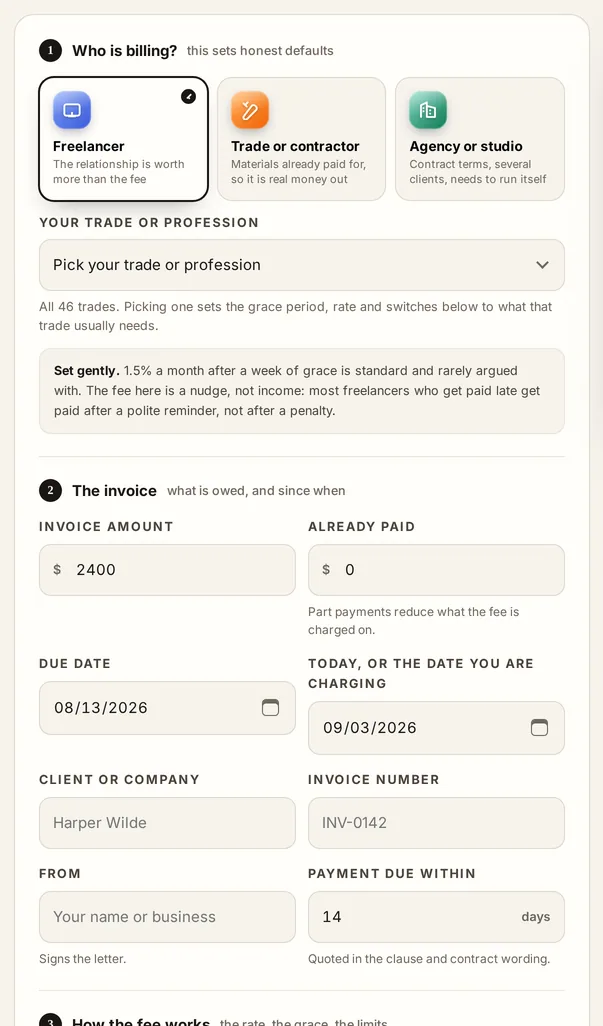
What you may charge, and after how long, is set by the law where you trade, so check the rule where you are before you set a figure. The late fee guide goes through what the statutes say in eight states and the wording that holds up.
The wording to put on the document
Short, in the same place every time, and next to the way to pay. Any of these reads correctly:
- Payment due within 30 days of the invoice date. Due 12 October 2026.
- Due on receipt. Payment is requested on delivery of this invoice.
- Net 14. A late fee of 1.5% a month applies to balances outstanding after the due date.
- 2/10 net 30. Deduct 2% if payment reaches us by 22 September 2026.
Put it under the totals, not in a footer nobody reads, and keep the wording identical on every invoice you send. A term that changes from one invoice to the next is a term the client will ring you about.
Setting them here
On any design in the studio the terms are a row of chips above the document. Pick one and the due date is calculated from the issue date and printed; type your own wording instead and it is used as it stands. Only a net number can move the date, because only a number says how many days.
The exact wording for the terms line
Most invoices carry the term and leave the reader to work out the date. Write both, in the same line, in the order a person reads them.
| Instead of | Write | Why |
|---|---|---|
| Net 30 | Payment due 12 October 2026 (net 30 from invoice date) | The date is what gets diarised; the term explains it |
| Payment on receipt | Payment due on receipt, today, 12 September 2026 | On receipt with no date is a term with no deadline |
| 30 days | Payment due within 30 calendar days, by 12 October 2026 | Calendar or business days is the commonest quiet disagreement |
| See terms overleaf | The terms, on the front, under the total | Anything a client has to turn over is a reason to put it down |
Put the way to pay directly underneath: the bank details, or the payment link. A due date with no method attached asks the client to go and find one, and that gap is where an invoice sits for a week.
Changing terms with a client you already have
Shortening the terms on the next invoice without saying anything reads as a mistake and gets queried, which costs you more time than the change saves. Say it once, in advance, in one sentence: from October, invoices go out on net 14. Give the reason if there is one and leave it there.
If the client is on a purchase order system, the terms may be set by their side rather than yours. That is a purchase order conversation, and the number on the invoice matters more than the term on it.
A term you do not enforce is not a term. If net 14 passes and nothing happens until day 40, the real term is net 40 and the client has learned it. Decide in advance what day one of chasing looks like, and keep it the same every time.
The tools for this
Common questions
What does net 30 mean on an invoice?
Payment is due 30 days after the invoice date. The word net means the full amount, with nothing deducted, and the number is the count of days. Net 30 on an invoice dated 12 September is due on 12 October.
Is net 30 counted in calendar days or business days?
Calendar days, unless the invoice says otherwise. If you mean business days you have to write business days on the document, and it is better to give a date than to make anyone count.
What is 2/10 net 30?
Two per cent off if they pay within 10 days, otherwise the full amount by day 30. It is an early payment discount, and it costs you two per cent to be paid twenty days sooner.
What are the best payment terms for a small business?
Shorter than net 30 unless a client's accounts process requires it, and the same on every invoice so nobody has to look. Net 14 is common for services, net 7 is not unusual on a small job, and a trade doing a same-day call-out usually asks for payment on the day. What matters more than the number is that the due date is printed and the way to pay is on the page.
Can I change the payment terms after I have sent the invoice?
Not by yourself. The terms on the invoice are the ones the client agreed to when they accepted the work. Shortening them afterwards is a new agreement, so raise it as a conversation rather than a corrected invoice.
Do payment terms have to be on the invoice?
Whether they are compulsory depends on where you trade. Whether they help is not in doubt: an invoice with no due date has no day on which it becomes late, which makes chasing it a matter of opinion.
What is the difference between net 30 and due in 30 days?
Nothing, if both are counted from the invoice date. The risk is that net 30 is jargon and due in 30 days is not, so a client who has never seen net 30 may file it and count from the day they opened the email. Writing the actual due date removes the question.
Read next
What this is. A guide and template written by James Carter. It is not legal advice. Deposit, cancellation and late fee rules differ by state, so have any wording you rely on checked for your state before it goes on a real document.
Last reviewed by InvoiceTools, Houston, Texas, on 30 July 2026.