The short version
Name the currency next to every figure, not just the total. Say who pays the bank charges. Carry both tax numbers where they exist. And give them a way to pay that is local to them, because an international wire is the slowest and most expensive option on the list.
The four things a cross-border invoice adds
A cross-border invoice is an ordinary invoice plus four decisions. None of them is difficult. All four cost money if you leave them implicit.
Which currency, and saying so
Invoice in your own currency and the exchange risk is the client's; invoice in theirs and it is yours. Neither is wrong. What is wrong is an invoice where the currency is ambiguous, and it is easier to be ambiguous than you would think: $ is used by more than twenty countries.
- Write the code, not just the symbol. USD 2,300.00 rather than $2,300.00 where there is any doubt about which dollar.
- Put it next to every figure, or state it once in large type near the totals. A subtotal in one currency and a total that looks like another is a query.
- If you invoice in their currency and keep books in yours, note the rate you used and the date. It makes your own records reconcile.
- Do not convert twice. Quote in one currency and invoice in the same one, or the client will compare the two and find a difference.
The editor here carries thirty-three currency symbols and a box to type your own, so a currency not on the list is a two-second job rather than a reason to use the wrong symbol.
Who pays the bank
This is the one that quietly eats margin. An international transfer can be charged to the sender, shared, or taken out of the amount in transit, and in the last two cases the money that lands is less than the invoice said. On a small invoice the charge can be a material share of it.
One line fixes it. "All bank charges, including any intermediary bank fees, are payable by the sender." Put it in the payment block, not in the terms at the bottom, so it is read by the person setting up the transfer.
Better still, avoid the wire. Several services give you local account details in the client's country, so they make a domestic transfer, which is cheaper for them and faster for you. Ask the client what is normal where they are; the answer is often a payment method you have not considered.
Tax, and why this section is short
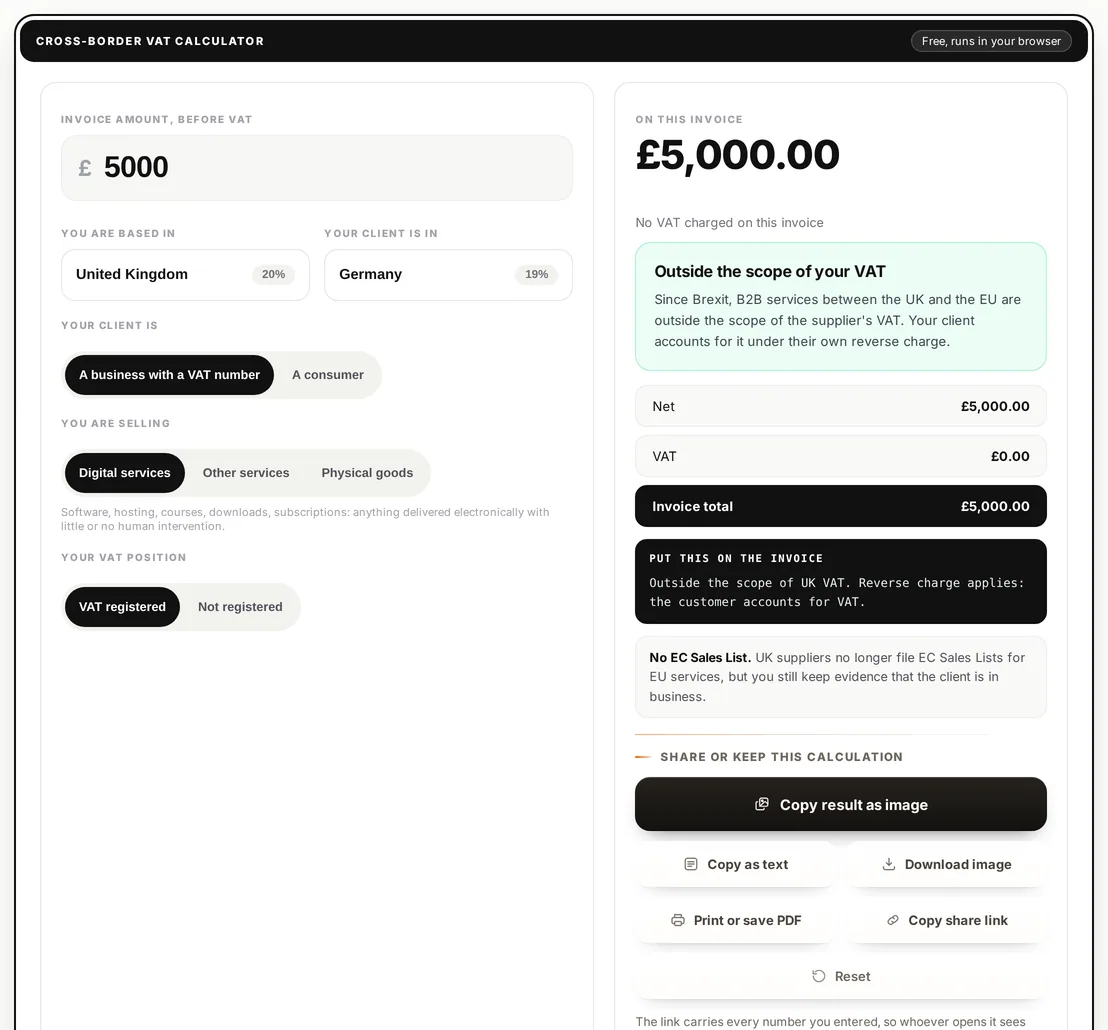
Whether you charge tax to an overseas client depends on where you are, where they are, what you are selling, whether it is goods or services, and whether they are a business or a consumer. There is no single answer and any figure printed here would be wrong for most readers.
What is generally true, before you ask your own accountant:
- Business to business across a border is frequently zero-rated or handled by the buyer, rather than taxed by you.
- The reverse charge is the mechanism in several systems for exactly that: the buyer accounts for the tax, and your invoice carries none but must say the reverse charge applies.
- Both tax numbers usually belong on the document where they exist: yours and the client's. Where a rule requires it, an invoice without them will not do the job it is for.
- Consumers are different from businesses, and digital services are different from physical goods. These are the two distinctions that change the answer most often.
Then check the rule where you file. The VAT calculator · GST Calculator will add or extract at whatever rate turns out to apply, and the tax on invoices guide covers how to lay it out once you know.
The rest of the document
| Field | Domestic | Across a border |
|---|---|---|
| Your address | Street and ZIP code | Street, ZIP code and country |
| Their address | Same | Same, plus country |
| Currency | Assumed | Stated, with the code |
| Tax numbers | Yours, if registered | Yours and theirs, where they exist |
| Bank details | Account and sort code | IBAN or account, SWIFT or BIC, bank address |
| Charges | Not mentioned | Stated: sender pays |
| Terms | Net 30 | Net 30, and allow for the transfer taking days |
One practical point on that last row. An international transfer can take several working days to arrive, so a client who pays on the due date is still paying you late in the sense that matters. If a due date is important, say when the funds must have cleared, not when payment must be sent.
Language, dates and the small stuff
- Dates. 09/03/2026 is two different days depending on the reader. Write 3 September 2026, or 2026-09-03. Never the ambiguous form.
- Number formats. 1,000.50 and 1.000,50 are the same amount to different readers. The currency code next to the figure resolves most of it.
- Language. An invoice in English is usually accepted. If the client's accounts team works in another language, a second copy costs you nothing and gets you paid sooner.
- Your own name. Use the legal name exactly as it appears on your registration. Cross-border payments get held up on name mismatches more than on anything else.
Which currency to invoice in
Whoever invoices in their own currency hands the exchange risk to the other side. Choose the currency deliberately instead of defaulting.
| Invoice in | You get | The client gets |
|---|---|---|
| Your currency | A known amount, whatever the rate does | A total that moves between the quote and the payment |
| Their currency | An amount that moves with the rate | A figure they can approve without converting anything |
| A third currency | Conversion costs on both sides | The same, usually for no benefit |
If you invoice in their currency, say on the quote which rate and which date you used, and whether a long gap between quote and invoice reopens it. On a job running for months, that sentence is the difference between a rate move you planned for and one you absorb.
What the bank takes, and who pays it
An international payment can lose money in three places, and none of them appear on your invoice unless you put them there.
- The sending fee, charged by the client's bank.
- Intermediary or correspondent fees, taken in transit, often without either side being told in advance.
- The exchange spread, which is usually larger than the fee and never itemized.
Say on the invoice who carries the charges. The plain wording is one line: please send the full invoice amount, with any transfer charges paid by the sender. Without it you receive an amount slightly under the total and have to decide whether to chase the difference.
Reconcile against the invoice, not against what landed. A short payment on an international transfer is usually bank charges rather than a dispute. Check the remittance advice before you chase, and if the shortfall repeats, change the wording rather than the client.
Tax across a border is its own question and often moves the obligation to the buyer, with a specific form of words required on the document. The sales tax guide covers what goes on the invoice, and the rules depend on where each of you trades.
The tools for this
Common questions
Which currency should I invoice in?
Yours, if the client will accept it, because then the exchange risk is theirs. Theirs, if it wins you the work or the client is much larger than you. Either is fine as long as the invoice says which, next to every figure.
Who pays the international transfer fee?
Whoever the invoice says. If it says nothing, it usually comes out of the amount that reaches you. One line settles it: all bank charges are payable by the sender.
What is the reverse charge?
A rule in some tax systems where the buyer accounts for the tax rather than the seller charging it. Where it applies, the invoice carries no tax and says so, and it has to state that the reverse charge applies.
What is the best way to get paid from another country?
Ask the client what is normal for them. A local transfer in their country, through a service that gives you local details, is usually cheaper and faster than an international wire, and far better than a foreign check.
What exchange rate should I use on an international invoice?
The rate on the invoice date, from a source you can point to, stated on the document with its date. Put it on whenever you invoice in a currency other than the one your records are kept in: it makes your bookkeeping match and stops an argument about the figure later. Which rate is acceptable for tax purposes depends on where you trade, so check your own rules.
Do I need to charge tax when invoicing a client in another country?
It depends on where you are registered, where the client is, what you are selling and whether the client is a business. Some supplies move the obligation to the buyer, some are outside the scope entirely, and some are taxed exactly as they would be at home. Check the rules where you file rather than copying a template.
Read next
What this is. A guide and template written by Emily Johnson. It is not legal advice. Deposit, cancellation and late fee rules differ by state, so have any wording you rely on checked for your state before it goes on a real document.
Last reviewed by InvoiceTools, Houston, Texas, on 3 September 2026.