The short version
Tax goes on its own line between the subtotal and the total, with the rate beside it. The discount comes off before the tax is worked out. Whether you charge it, at what rate, and on what, is set where you trade, so check the rule where you file.
What the total is made of
Every invoice total is the same short sum, and the order of it matters because each step feeds the next.
- Subtotal. The lines added up, before anything else happens.
- Discount. Taken off the subtotal. This is the step people get wrong: applying it after tax means the client pays tax on money they were never charged.
- Tax. Worked out on what is left, at the rate you show.
- Anything already paid. A deposit, a part payment, a credit note.
- Balance due. The only figure the client acts on, so make it the largest thing on the page.
Per line, or one rate on the subtotal
Both are correct and they answer different situations.
| One rate on the subtotal | Tax per line | |
|---|---|---|
| Use it when | everything on the invoice is taxed the same way | some lines are taxed and others are not, or rates differ |
| Reads as | simpler, and easier for a client to check | busier, but unarguable |
| Typical for | services billed at one rate | goods and services mixed, or multiple jurisdictions |
| On this site | the tax row under the subtotal | the tax column, switched on per design |
If in doubt, show more rather than less. A client who can see how the tax was worked out does not ring you about it. A single figure with no rate beside it is the line that generates the query.
Tax invoice against invoice
In many countries a document only counts as a tax invoice if it carries specific things, and a client who is reclaiming the tax needs it to. What is required varies, but the list is usually close to this:
- The words Tax Invoice as the title.
- Your tax registration number.
- The client's tax number, where they have one and the rules ask for it.
- The rate applied, shown next to the amount.
- The tax amount, shown separately from the net amount.
- The date of supply, where it differs from the invoice date.
Every one of those is a field on the designs here: the title is editable, the tax number sits in the header block, and the tax line carries the rate. The glossary entry has the short version.
Tax inclusive and tax exclusive
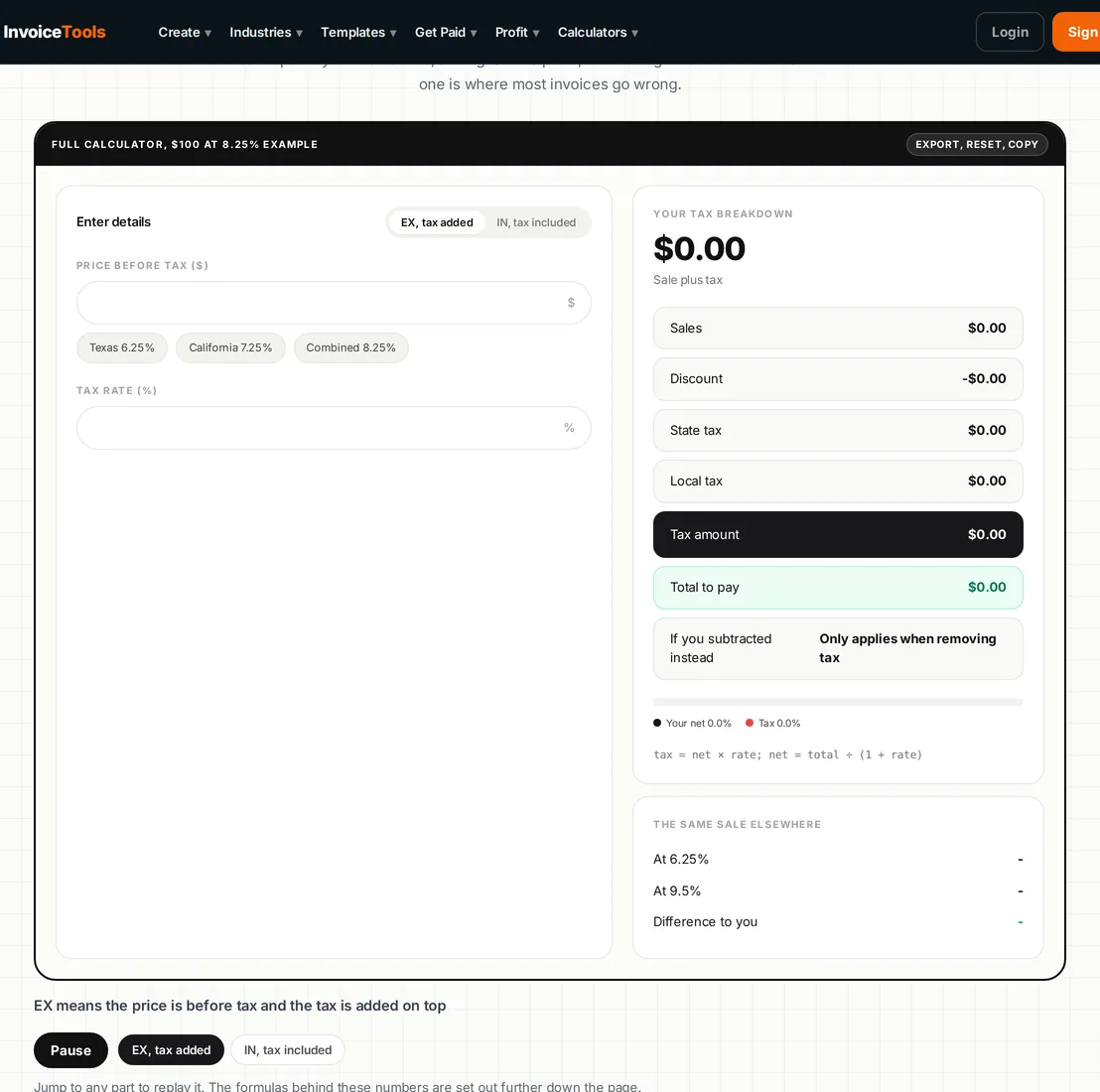
Tax exclusive means the prices you list are before tax and the tax is added. Tax inclusive means the listed price already contains it. Both are normal; which is normal depends on where you are and who you sell to. Businesses usually quote exclusive, consumers usually see inclusive.
The rule that matters: say which one you are doing. "All prices exclude sales tax" or "Prices include VAT at 20%", once, near the totals. A quote that turns out to have been exclusive when the client read it as inclusive is a twenty per cent argument.
The parts that catch people
- Shipping and delivery. Taxable in some places, not in others. Put it on its own line so whichever answer applies is visible.
- Reimbursed expenses. Passing on a cost you incurred is not always the same as selling it. Check before you decide whether tax goes on top.
- Deposits. Tax may fall due when the deposit is taken rather than when the job finishes. If so, the deposit invoice needs its own tax line.
- Rounding. Round the tax once, at the end, to two places. Rounding per line and adding up gives a figure that does not match the client's own calculation.
- Credit notes. A credit note reverses the tax as well as the net. Crediting the net only leaves the tax overpaid.
Where the tax line goes on the document
Tax belongs between the subtotal and the total, on its own line, with the rate written next to it. A total with tax folded invisibly inside it is the fastest way to get an invoice queried by anyone who has to reclaim it.
| Line | Example | Why it is separate |
|---|---|---|
| Subtotal | 1,200.00 | What the work costs before tax |
| Tax | Sales tax at 8.25%: 99.00 | The rate has to be visible for the client to check it |
| Total | 1,299.00 | What they pay |
Where you are registered, the registration number goes on the invoice too. Which number, and whether it is compulsory, depends on where you trade, so check your own rules rather than copying a template. The sales tax calculator and the VAT calculator or GST Calculator both work forwards from a net figure and backwards from a gross one.
Discounts, shipping and the order of operations
A discount applied before tax and a discount applied after tax give different totals. Take 10 per cent off 1,200 and you tax 1,080; tax 1,200 first and you take 10 per cent off 1,299. Almost everywhere the first is correct, because tax is charged on what the customer actually pays for the goods.
- Discounts: apply to the line or the subtotal, then tax the result. The discount calculator shows both figures.
- Shipping and delivery: taxable in some places and not in others, and sometimes only when the goods themselves are taxable. It is a line of its own either way.
- Mixed rates on one invoice: group the lines by rate and show a tax line for each, rather than one blended figure nobody can check.
- Exempt lines: show them at zero with a note saying why, not left off. An invoice that does not add up gets queried.
Selling to a business, and selling across a line on the map
Selling to another business does not remove the tax by itself. Some jurisdictions have an exemption or a reverse charge for business customers, and each one has its own paperwork: an exemption certificate, a registration number on the invoice, a specific form of words. Get the document before you invoice, not after the client queries the tax.
Crossing a border or a state line usually changes which rules apply, and sometimes moves the obligation to the buyer. The international invoicing guide covers what changes on the document.
The tools for this
Common questions
Where does sales tax go on an invoice?
On its own line between the subtotal and the total, with the rate next to it. Never folded into the line prices without saying so, and never left off the document when you have charged it.
Should tax go on each line or on the subtotal?
One rate on the subtotal is simpler and is right when everything on the invoice is taxed the same way. Tax per line is necessary when some lines are taxed and others are not, or when different lines carry different rates.
Is the discount taken before or after tax?
Before, in almost every system: the discount reduces the taxable amount and the tax is worked out on what is left. Applying it after tax overcharges the client.
What is a tax invoice?
An invoice that carries the extra details a tax authority requires, which usually means your tax registration number, the rate applied, the tax amount shown separately, and the words tax invoice as the title.
Do I charge tax on shipping or delivery?
That depends where you are. Some places treat delivery as part of the taxable sale and some do not, so check the rule where you file. Put delivery on its own line either way, so the answer is visible.
Do I have to show sales tax separately on an invoice?
Where you are registered, generally yes, and it is good practice everywhere. The client needs the rate and the amount to check the figure and, if they can reclaim it, to reclaim it. Whether it is a legal requirement depends on where you trade.
What do I put on an invoice if I am not registered for sales tax?
No tax line at all and no tax number, because you do not charge it. Do not add a zero per cent line unless the goods are genuinely zero rated: that says you are registered and this supply is taxed at zero.
Read next
What this is. A guide and template written by Emily Johnson. It is not legal advice. Deposit, cancellation and late fee rules differ by state, so have any wording you rely on checked for your state before it goes on a real document.
Last reviewed by InvoiceTools, Houston, Texas, on 18 August 2026.