The short version
A retainer invoice is the same amount on the same day each month for a written scope. Bill it in advance, keep it in your normal number sequence, and put the scope on the invoice itself so anything outside it is visibly a separate job.
What a retainer actually buys
Two different things get called a retainer and they behave differently.
- A retainer for availability. The client pays to have first call on your time. They may use none of it in a quiet month; they are buying the certainty, not the hours.
- A retainer for a block of work. An agreed amount of work every month: so many hours, so many posts, so many visits. Closer to a subscription than to a booking.
Write down which one it is. Almost every retainer argument is two people who each thought it was the other.
What the agreement has to say
- The amount, and what it covers. In hours, in deliverables or in availability. Be specific enough that both of you could tell whether a given request is inside it.
- What happens to unused time. Use it or lose it, or roll it forward for one month. Never roll indefinitely: you end up owing a client a quarter of free work.
- What happens when they go over. The hourly rate for anything beyond the block, and whether you need approval first.
- The notice period. Both ways. Thirty days is common.
- The review date. Annual, in writing. Without it the price is frozen at whatever you charged when you knew least.
- When it is billed. In advance, on a named day of the month.
The scope belongs on the invoice, not only in the agreement. One line under the description: "Monthly retainer, September 2026. Includes up to 12 hours of support." Nobody digs out a contract to check an invoice, and that line is what makes extra work visibly extra.
Numbering a monthly series
Keep retainer invoices in the same sequence as everything else. It is tempting to give them their own run, and it makes the year impossible to add up. The period goes in the description, not in the number.
| Do | Do not | |
|---|---|---|
| Number | INV-2026-0041, then 0042 next month | RET-09, RET-10, in a sequence of their own |
| Description | Monthly retainer, September 2026 | Retainer (no period at all) |
| Dates | Issued 1 September, due 1 September | Issued whenever you remember |
| Extra work | A separate invoice, or a separate line | Quietly absorbed, then resented |
When a retainer is the wrong shape
A retainer suits work that recurs. It does not suit work that happens once and takes three months, which is a project with staged payments, and it does not suit work whose volume swings wildly, which is hourly billing wearing a monthly hat.
The test: if you could not tell a client roughly what next month involves, a retainer will make one of you unhappy. Bill by stage instead.
Setting one up here
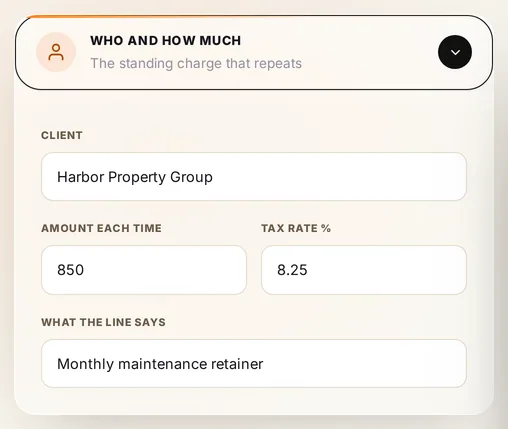
The recurring invoice tool takes the amount, the day of the month and how long it runs, and gives you the schedule. Pick a design in the templates and the same one carries every month, which is worth more than it sounds: a client who recognizes the document opens it faster.
Pricing a retainer without guessing
Two numbers decide it: what the work costs you in time, and what the certainty is worth to both of you. Start with the first, because it is the one you can calculate.
- Write down what a typical month actually contains. Not the busy one and not the quiet one. The tasks, and the hours each takes.
- Price those hours at your normal rate. The rate calculator works back from what you need to earn and the hours you can actually bill.
- Add the time the arrangement itself costs. The standing call, the inbox, the context you hold for them between jobs. It is real work and it disappears from every retainer that was priced on deliverables alone.
- Decide what the discount is, and say it out loud. Many retainers are priced below the hourly equivalent because the income is predictable. That is a fair trade as long as both of you know it is the trade being made.
- Set the review date now. A retainer with no review date is a price frozen at the moment you knew least about the work.
Bill the same amount even in a quiet month. Discounting the months where the client used less turns availability into hourly billing with extra steps, and it teaches the client to expect a refund in every quiet month. If quiet months keep happening, change the retainer at the review, not on the invoice.
Ending one without losing the client
Retainers end. The ones that end badly are the ones that stop without a conversation, usually because the notice period was never written down.
- Give the notice you agreed, in writing, with a final date. The last invoice should not be a surprise.
- Say what happens to work in progress. Anything half finished is either completed inside the notice period or quoted separately.
- Send a final invoice that says final on it. Include the period it covers, so their accounts team can close the account rather than wait for another one.
- Offer the shape that fits now. A client who no longer needs a monthly block may still need occasional work. Quote it as jobs, with a quote each time, and the relationship survives the arrangement.
The tools for this
Common questions
What is a retainer invoice?
An invoice for an agreed amount, sent on the same day each month, for an agreed scope of work. The point is that neither side has to negotiate or remember anything for it to happen.
What is the difference between a retainer and a deposit?
A deposit is a part payment against one job, taken before it starts and deducted from the final invoice. A retainer is a recurring fee for ongoing availability or ongoing work, and it is not deducted from anything.
How do I number a monthly retainer invoice?
In the same sequence as everything else you send, one per month. Adding the period to the description rather than to the number keeps one sequence, which is what makes the year add up.
What happens if the client uses less than the retainer covers?
Whatever the agreement says, which is why it has to say something. The two common answers are use it or lose it, and roll unused hours forward for one month. Both are fine; leaving it unwritten is not.
Can I raise a retainer mid-term?
Only with notice you agreed in advance. A retainer with no review date is a price frozen at the moment you were least experienced, so put an annual review in the agreement from the start.
Should a retainer be paid in advance or in arrears?
In advance, for the month ahead. The client is buying availability for a period that has not happened yet, and the cash arrives before the work rather than a month after it. If the client insists on arrears, the retainer has become an ordinary monthly invoice for hours, which is a different agreement.
What happens if a retainer client goes over their hours?
Whatever the agreement says, which is why it has to say something. The workable version is a stated hourly rate for anything beyond the block and your approval before the extra work starts, billed as a separate line so the client can see the retainer and the overage apart.
Read next
What this is. A guide and template written by Fatima Khan. It is not legal advice. Deposit, cancellation and late fee rules differ by state, so have any wording you rely on checked for your state before it goes on a real document.
Last reviewed by InvoiceTools, Houston, Texas, on 12 August 2026.