The short version
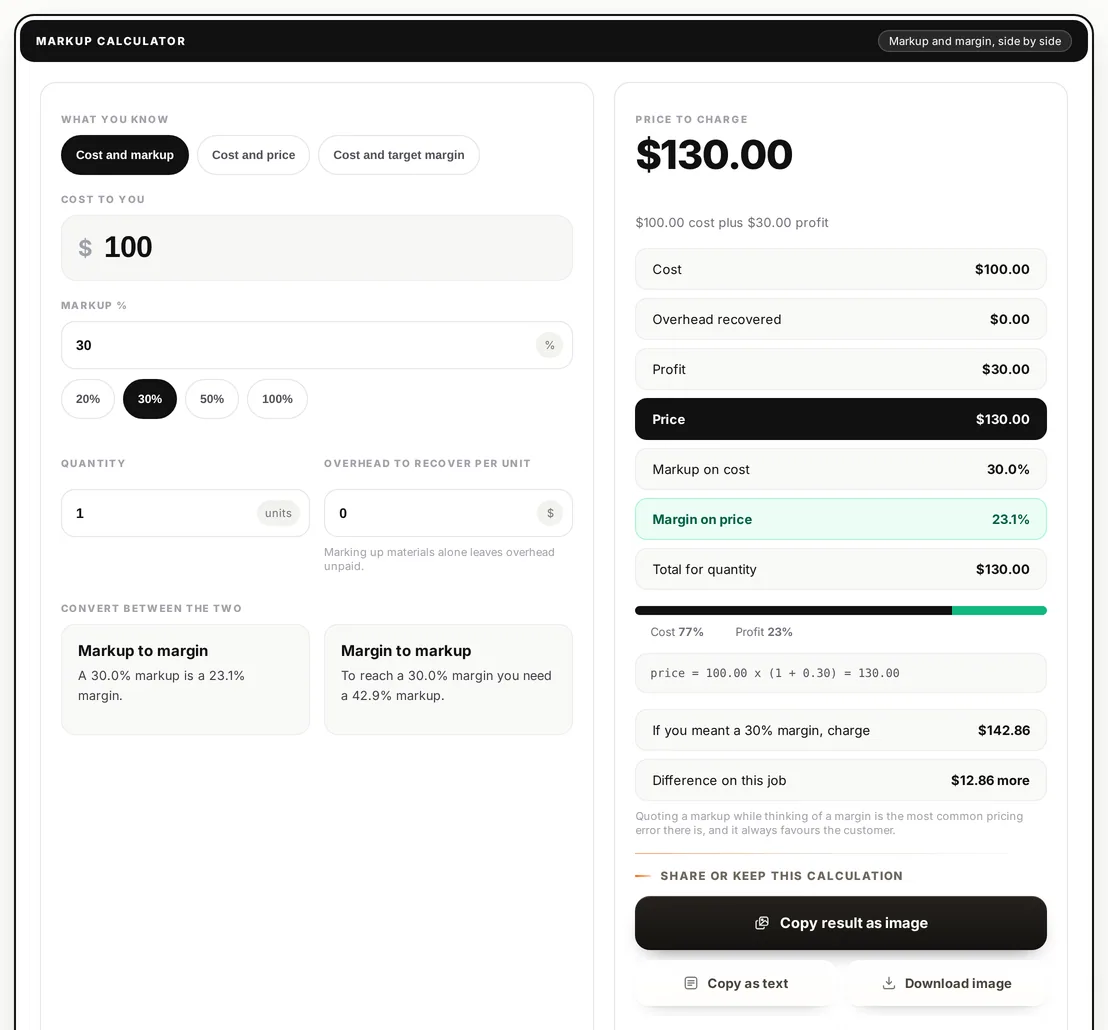
Markup is measured against what the job cost you. Margin is measured against what you charged. A 50% markup is a 33% margin, and quoting one while budgeting for the other is how a busy year ends with no money in it.
The one piece of arithmetic that matters
Markup answers: how much did I add on top of my cost. Margin answers: how much of what I charged did I keep. They use the same profit and divide it by different things, which is why they are never the same number.
| Markup | Margin | On a cost of 1,000, the price is |
|---|---|---|
| 10% | 9.1% | 1,100 |
| 25% | 20% | 1,250 |
| 33% | 25% | 1,330 |
| 50% | 33% | 1,500 |
| 66% | 40% | 1,660 |
| 100% | 50% | 2,000 |
| 150% | 60% | 2,500 |
Read that table once and the trap is obvious. Somebody who wants to keep half of what they charge and applies a 50% markup keeps a third, and the missing sixth is the money that was supposed to be profit.
What the price has to cover
Three things, in this order, and skipping the middle one is the usual mistake.
- The direct cost of this job. Materials, subcontractors, rentals, disposal, and the hours somebody spends on it.
- A share of what the business costs anyway. The van, the insurance, the phone, the software, the accountant, the hours you spend quoting work you do not win. This does not disappear because a job is small.
- Profit. What is left after both. If your price only covers the first two, you have a job, not a business.
Overhead is recovered per hour, not per job. Add your annual overhead to what you want to earn, divide by the hours you can actually bill, and you have an hourly figure that carries its share of the running costs. Every hour you quote at less than that is subsidized by another job.
Labor, and the hours nobody bills
A labor rate is not a wage. It has to carry the wage, the employment costs on top of it, the overhead share, and the hours that are paid but not billable: travel, loading, the shop, the tidy-up, the day the job was canceled.
The gap between paid hours and billable hours is where trade pricing goes wrong. Somebody paid for forty hours who bills thirty is a rate a third higher than the wage before anything else has been added at all.
Materials, and the markup nobody argues with
Marking materials up is normal and defensible: you are carrying the cost, the sourcing, the collection, the waste and the warranty. Arguments come from a client who sees the trade price somewhere and compares.
- Quote materials and labor as one figure on a fixed-price job. The client is buying an outcome, not a shopping list.
- Itemize them on time and materials work, where that is the deal, and say what the markup is in the terms rather than hiding it in the unit price.
- Put an allowance on anything not chosen yet, name it as an allowance, and say what happens if the choice costs more.
Pricing a job you have not done before
- Price the parts you have done before at what they actually took, not at what you hope they take.
- Put a named allowance on each part you cannot price, with the assumption written next to it.
- Send it as an estimate, not a quote, so the figure is allowed to move.
- Record what it actually took. One job priced badly is tuition; the same job priced badly twice is a habit.
Getting it onto paper
Once you have the number, the document decides whether it survives. A single total invites haggling over the whole thing; an itemized price moves the conversation onto individual lines, which is a much better conversation to be having. The quote templates itemize by default and carry the valid-until date, which matters when material prices move.
The three shapes a price can take
The same job priced three ways carries the risk in three different places. Choose the shape before you choose the number.
| Shape | Who carries the risk | Right when |
|---|---|---|
| Fixed price | You | The scope is clear and you have done it before |
| Day or hourly rate | The client | The work is open ended or the scope will move |
| Time and materials | Shared | Materials vary and the labor is measurable |
A fixed price on a job you cannot describe precisely is a bet you will usually lose, because the scope only ever grows. If you want a fixed price on unclear work, price the clear part fixed and put the rest behind a change order.
The costs that get left out
The commonest reason a profitable-looking job is not profitable is that the price covered the work and nothing around it.
- Travel and time on the road. Two hours of driving is two hours you cannot sell to anyone else.
- Setting up and clearing away. Real hours on almost every trade job, and almost never quoted.
- Waste, returns and the trip back to the merchant. Materials carry markup for this reason, not as a mark-up on principle.
- Quoting itself. The site visit, the write-up, the follow-up. Every job you win pays for the ones you did not.
- The money you carry. Materials bought up front and paid for on net 30 are your cash sitting in someone else's building. A deposit moves that.
- Overhead. Insurance, the van, the phone, the accountant. Spread across the hours you can actually bill, not the hours in a week.
Work the last two out once a year rather than per job. The break-even calculator turns fixed costs into the figure you have to cover before anything is profit, and the rate calculator turns a target income into an hourly number.
The tools for this
Common questions
Is a 50% markup the same as a 50% margin?
No. A 50% markup on a cost of 1,000 gives a price of 1,500, and 500 profit on a 1,500 price is a margin of 33%. To get a 50% margin you would have to charge 2,000, which is a markup of 100%.
How do I convert markup to margin?
Margin equals markup divided by one plus markup. A 25% markup is a 20% margin; a 50% markup is a 33% margin; a 100% markup is a 50% margin.
What markup should a contractor use?
Whatever covers overhead and leaves a profit, which is a number only your own books can give you. The mistake is using a figure someone quoted online without checking it against what your business actually costs to run.
What is the difference between overhead and cost of goods?
Cost of goods is what a specific job consumed: materials, subcontractors, the hours on site. Overhead is what the business costs whether or not that job happened: the van, insurance, the phone, the accountant.
Should the markup be the same on materials and labor?
Not usually. Materials carry less risk and less overhead than labor does, so many trades mark materials up less and labor more. What matters is that the two together cover the whole job.
How do I price a job I have never done before?
Price the parts you know, put a named allowance on the parts you do not, and send it as an estimate rather than a quote so the figure is allowed to move. Then record what it actually took.
How do I work out a day rate?
Start from what you need to earn in a year, add your overhead, then divide by the days you can realistically sell. The last figure is the one people get wrong: vacation, admin, quoting and the days nobody books mean the billable count is well under the working count.
Should I show my hourly rate on a quote?
Only if you are charging by the hour. On a fixed price the client is buying an outcome, and showing the rate invites a conversation about how long it should take rather than about what it is worth. On time and materials the rate has to be there, because it is what the bill is built from.
Read next
What this is. A guide and template written by Michael Reed. It is not legal advice. Deposit, cancellation and late fee rules differ by state, so have any wording you rely on checked for your state before it goes on a real document.
Last reviewed by InvoiceTools, Houston, Texas, on 23 August 2026.