The short version
A freelance invoice needs your name and details, the client's, a unique number, an issue date, a due date, the work itemized, the total and how to pay. Set the rate by working back from what you need to earn, not by copying somebody else's. Send it the day the work ends.
What goes on the page
There is no special freelance invoice. It is an ordinary invoice with the company furniture switched off, and it needs the same eight things every invoice needs.
- Who you are. Your legal or trading name, an address and a way to reach you. A sole proprietor uses their own name; there is nothing to invent.
- Who it is for. The client's legal or trading name, not the name of the person you deal with. A company's accounts system matches on the former.
- A unique number. One sequence, never reused. INV-2026-0001 upward sorts correctly and tells you the year at a glance.
- The issue date. The date you send it, which is the date every term counts from.
- The due date. Printed as a date, not only as a term.
- The work, itemized. One line per deliverable or per block of hours, with a quantity and a rate. A single line saying "consultancy" invites a question.
- The total. With tax on its own line if you charge it.
- How to pay. Bank details, a link, or both. An invoice with no way to pay on it is a request to be asked how.
Two fields worth filling even when they look optional. If the client uses purchase orders, put their PO number on the invoice: it is the single most common reason an invoice sits untouched in a large company. And if you are registered for tax, print the number, because their accounts team may not be able to pay you without it.
The rate, worked out rather than guessed
Most freelancers set a rate by looking at what someone else charges. That tells you what the market bears; it does not tell you whether you can live on it. The arithmetic that does is short.
The step people get wrong is the third one. Forty hours a week over fifty weeks is two thousand hours, and almost nobody bills two thousand hours. Selling the work, doing the admin, chasing the invoices, learning the thing, the week nobody books you: all of it comes out of the same two thousand. Half is a realistic starting assumption, and if you count forty you will set a rate that is half what you need.
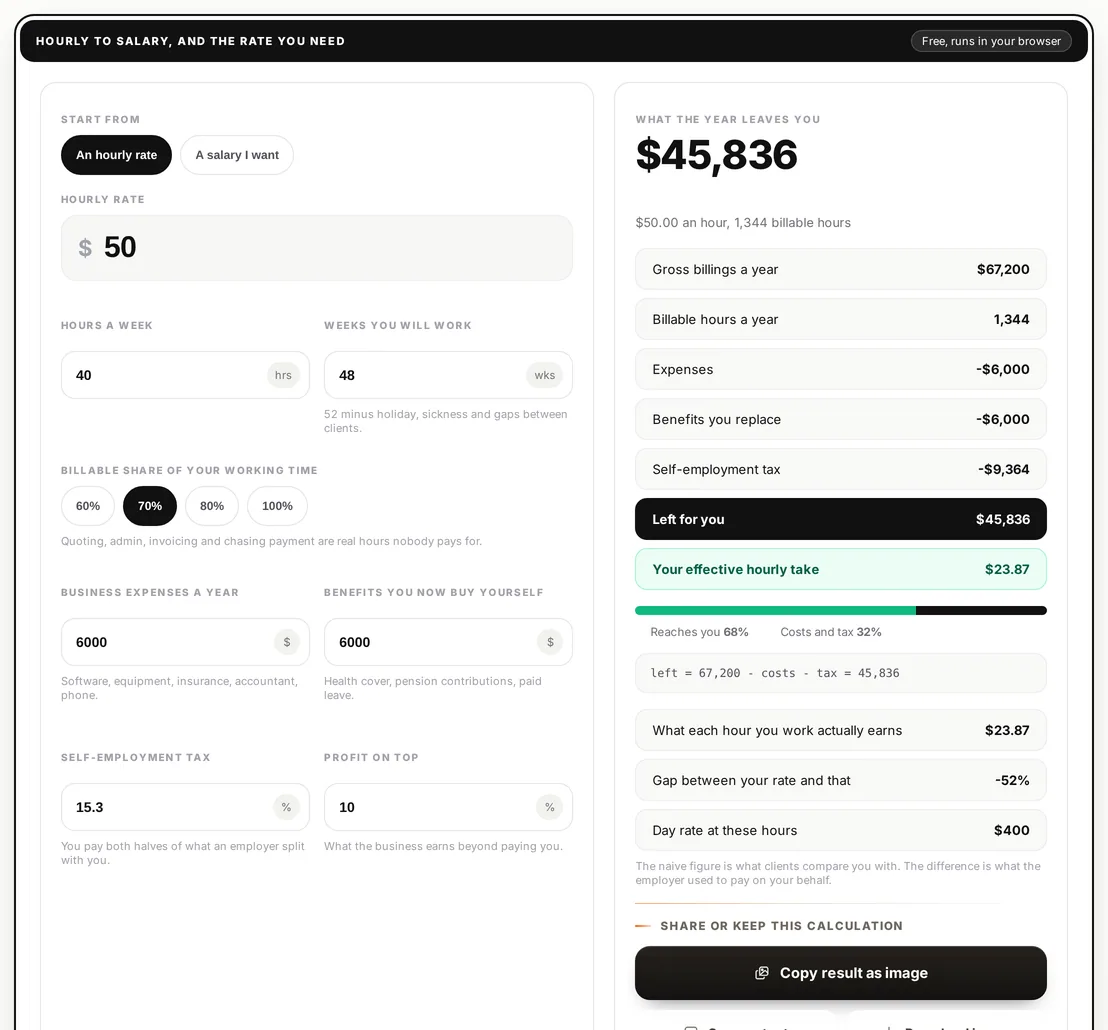
Once you have the floor, the project fee follows from it. A fixed price is not a different pricing model so much as a bet: you are betting you can do it in fewer hours than the client would have paid for. Work out the hours first and you know whether the bet is a good one.
Hourly, daily or fixed
| Bill hourly when | Bill a fixed fee when | |
|---|---|---|
| The scope | is not settled, or the client keeps changing it | is written down and you both agree what it is |
| The risk | sits with the client: more work costs them more | sits with you: overrun comes out of your margin |
| What you need | an honest record of hours | an honest estimate, and a change order when it moves |
| What it rewards | nothing in particular | getting faster at the work |
A day rate sits between the two and is worth using where a day is the natural unit: shoots, workshops, on-site work. Say what a day is. Seven hours and ten hours are both defensible and they are not the same product.
Tax, in one honest paragraph
Whether you charge sales tax or VAT, at what rate, and from what threshold, is set by where you trade and what you sell. Nothing on a template site can tell you your answer, and a figure printed here would be wrong for most readers. What is true everywhere: if you do charge, show it on its own line with the rate next to it, and keep the invoices you send, because the record is what the return is built from.
The other half is the tax you owe on what you earn. It is not on the invoice, but it decides what the invoice has to be worth: money you set aside for tax is not income, and a rate calculated without it is a rate that leaves you short in January.
The three habits that decide whether you get paid
- Send it the day the work ends. Not at the end of the month. Every day between finishing and invoicing is a day added to the wait, and it is the only part of the wait entirely in your hands.
- Put the way to pay on the document. Bank details, a link, a code they can scan. Anything that makes paying a decision rather than an errand.
- Chase on a schedule, not on a feeling. A short note the day after it falls due, then a call, then the overdue notice. Written down in advance it is admin; left to the day it feels like a confrontation.
The chasing guide has the wording for each stage, and the payment terms guide covers what to put in the terms line.
Doing it here
Two routes, depending on whether you want to be walked through it. The invoice generator asks for your trade first and loads the lines that trade usually bills for. The templates give you 278 designs to type straight into. Both export a PDF, and nothing you type leaves the browser.
Invoicing an agency is not invoicing a client
The same work billed to an agency and billed directly needs two different invoices, because two different people have to approve it.
| Direct client | Agency or larger company | |
|---|---|---|
| Who approves | The person who hired you | A producer, then accounts, sometimes a system |
| What they need | A clear description and a total | A PO number, a supplier reference, sometimes a portal upload |
| Timing | Whenever the work is done | Often a cut-off date each month, and you miss the run if you are late |
| Terms | Whatever you agreed | Frequently theirs, set by their process rather than by you |
Ask two questions before the first invoice, not after: is there a purchase order number, and is there a date each month after which invoices go into the following run. Those two answers move payment more than any wording on the document. The purchase order guide covers what happens when the number is missing.
Charging for the parts that are not the work
- Revisions beyond the agreed round. Say how many are included in the quote, then bill further rounds as a line rather than absorbing them.
- Kill fees. Agree the percentage before you start, so a canceled job has a number attached to it rather than a negotiation.
- Licensing and usage. A photograph or an illustration used somewhere new is a new license, not a favour.
- Expenses. Travel, stock, subscriptions bought for the job. Itemize them, keep the receipts, and say up front whether they carry your markup or go through at cost. The pricing guide covers which.
The tools for this
Common questions
What is freelance invoicing?
Freelance invoicing is billing as a sole proprietor rather than a company: your own name or trading name, your own terms, and no payroll behind it, which makes the payment terms line the one that matters most.
How do I invoice a company for freelance work?
Address the invoice to the company's legal name and give your name and contact details, a unique invoice number, the date, the work itemized by hours or fixed fee, the total, a due date and how to pay. Ask for their PO number or the name of the person who approved the work before you send it, because a company's accounts team pays against those.
Do I need a company to send an invoice?
No. A sole proprietor invoices under their own name. Put your legal name where a company name would go, add your address, and add your tax reference if the place you trade in gives you one.
What should a freelancer charge per hour?
Work back from what you need to earn. Add your business costs to your target income, divide by the hours you can actually bill in a year, and that is your floor. The number of billable hours is the part people get wrong: it is nothing like forty a week.
Should a freelancer charge hourly or by the project?
Hourly protects you when the scope is unclear. A project fee pays you for the result rather than the time, which is better once you are fast at something. Either way, work out the hourly figure first, because it is what tells you whether the project fee is enough.
Do I have to charge tax on a freelance invoice?
That depends on where you trade, what you sell, and whether you are registered. Check the rule where you file. If you do charge, show it on its own line rather than folding it into the price.
How long should a freelancer give a client to pay?
Shorter than a big company would ask for. Net 14 is common, and due on receipt is reasonable for small jobs. What matters more is that the due date is printed and there is a way to pay on the page.
Should I ask a new client for a deposit?
On anything long enough to hurt if it goes unpaid, yes. A third up front is common. It also tells you something useful: a client who will not pay a deposit is a client who may not pay the invoice.
What should a freelancer put on an invoice?
Your name and address, the client's, an invoice number, the issue date, the due date, a line for each piece of work with its amount, the total, and how to pay. Add a tax number and a tax line if you are registered where you trade. The step by step guide shows each field on a real document.
How soon should a freelancer invoice after finishing work?
The same day where you can. An invoice sent a two weeks late has already spent a two weeks of its own payment term, and the person who approves it has to remember a job that is no longer in front of them.
Read next
What this is. A guide and template written by Sarah Thompson. It is not legal advice. Deposit, cancellation and late fee rules differ by state, so have any wording you rely on checked for your state before it goes on a real document.
Last reviewed by InvoiceTools, Houston, Texas, on 9 August 2026.